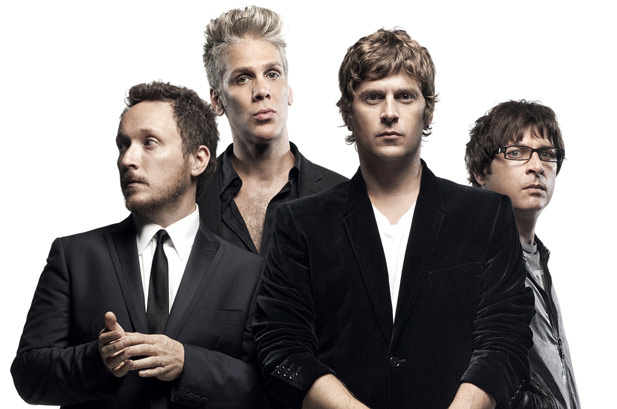
I still remember the first time I heard American Idiot in full.
It was my 14th birthday, and I’d been waiting for the better part of two
months to finally give the album a spin. The record dropped on
September 20, but as was the norm when I was young, broke, and trying to
cut back on downloading, I often had to wait awhile to buy CDs or ask
for them as gifts. Such was the case with Green Day’s first full-length
album in four years, which I scrawled on my birthday list between other
2004 albums like Keane’s Hopes and Fears and Sister Hazel’s Lift.
Indeed, it was a long and torturous wait to finally get the album in my
hands, on the evening of November 18th, 2004, but the result was the
kind of listening experience that you don’t get anymore. It was the
excitement of tearing open the wrapping paper on the disc at dinner; the
electricity of climbing the stairs to my room, breaking the cellophane
wrapper, and removing that annoying sticker thing along the top of the
case; the anticipation of placing the album in my CD player for the
first time, pushing play, and spending the next hour just letting the
music and the lyrics wash over me. And it was all magnified by the fact
that I was young and just beginning to discover what a huge role music
was going to play in my life.
There aren’t many “first listen” stories that I remember with the
clarity of that one, and for good reason. From the very first time I
heard American Idiot, I knew it was a record I was going to carry
with me forever, that it was an album that was really going to
“matter”—though not necessarily in the way that many people thought it was supposed to matter. In the years since, when I’ve talked about American Idiot
with fellow music fans, I’ve found that many people write the album off
for what they call “hollow political statements.” Such criticisms never
made sense to me because, from day one, I never heard American Idiot
as an overtly political record. Sure, “American” is in the title. Sure,
the album dropped during a particularly heated election year. And yes,
the guys from Green Day were never shy about telling everyone exactly
how the felt about President George W. Bush. But while the politics are
undoubtedly there in American Idiot, they never define it, which is a crucial point to make.
In that regard, American Idiot actually has a lot more in common with Bruce Springsteen’s Born in the U.S.A.
than it does with the rock operas and Broadway musicals from which
Green Day drew the bulk of their inspiration. No one could deny that Born in the U.S.A. had
political undertones (and sometimes, like in the title track,
overtones). But an honest and open listen to that album would reveal
that it’s about a lot more than just the Vietnam War and the politicians
responsible for it. On the contrary, Born in the U.S.A. is an
album about friendship, family, home, and how they all slip away too
easily. Just like that record captured what it was like to live in
America at a time when it was difficult to be proud about being from America, American Idiot captures just how fucked up things got in the wake of 9/11. So while it may have been labeled as a “Bush protest album,” American Idiot
is actually an album about living, loving, pursuing the American Dream,
and watching it all fall apart in the first decade of the new
millennium. Like the era that inspired it, American Idiot is an
album that exists under a specter of doubt, hate, fear, paranoia, and
rage, and there’s arguably no album in the world that better captures
the post-9/11 zeitgeist, or that sounds more like how 2004 felt.
Because of all that, it’s easy to see why American Idiot hasn’t aged quite as well as a lot of the albums I was spinning incessantly in the fall of 2004. Jimmy Eat World’s Futures, which dropped just a month after American Idiot,
still sounds as fresh as it did the first time I heard it. Plain and
simple, those songs have just continued to grow and change with me over
the past 10 years. When I listen to American Idiot these days, I still love the songs, but something about the record just feels intrinsically tied to the past for me.
That could have something to do with the album’s monumental mainstream
success: between 2004 and 2006, this record spawned five singles, four
of which were inescapable to anyone who ever turned on a pop or rock
radio station. The title track was the perfect lead-off, a song that
sounded like old Green Day while hinting at the more anthemic, serious
tone they were going for on this record, while “Boulevard of Broken
Dreams” doubles perfectly as an earworm pop single and a key cog in the
album’s storyline. The sobering “Wake Me Up When September Ends”
reignited a stream of rock bands trying to write sensitive acoustic
ballads, but remains powerful regardless for the way the normally
tongue-in-cheek Billie Joe Armstrong writes and sings about his late
father. And the raging “Holiday” remains one of the catchiest songs in
the band’s catalog—even if its rebellious lyrics sounded a lot cooler to
the 14-year-old version of me than they do to the 23-year-old one.
The fact that American Idiot was ever able to spawn one single of
any level of success, let alone five of them, was a remarkable feat.
Not only was Green Day coming off a commercial disappointment (2000’s
Warning) and a four-year hiatus that many categorized as the band in
mid-life crisis mode, but they were also re-entering the music world
just as the album format was breathing its last breaths of mainstream
importance. From Usher’s Confessions to the Killers’ Hot Fuss,
2004 was one of the last years where albums not written by Adele or
Taylor Swift could be counted on to spit out one ubiquitous hit after
another. Green Day managed just that, but what made the feat so
impressive was that American Idiot was a project that was absolutely meant to be heard all at once. Hot Fuss and Confessions
play just as well—if not better—by having their best songs split off
from the whole and played on compilations, mixtapes, or radio playlists.
That’s not something you could ever say about Idiot, which derives 90% of its power from the story and progression inherent in its 13-song tracklist.
Back in 2004, American Idiot’s story was a thing of much
conversation, both on music message boards and in school cafeterias. It
was never really difficult to follow the narrative of the Jesus of
Suburbia, who flees the suburbs for the city, gets mixed up with a bad
crowd, falls in love, ruins his life with drugs and excess, gets his
heart broken by the love of his life, and then returns to the exact
place he so heartily wanted to escape at the beginning of the story. But
there were always questions to be asked in there: was the St. Jimmy
character a literal drug dealer, or was he a new personality invented by
the Jesus of Suburbia to fit in with the city crowd? When Jimmy “blew
his brains out into the bay” during “Homecoming,” was it just Jesus
destroying the personality that had destroyed him? And who the hell was
Tunny, the character who showed up—in the liner notes, at least—during
the Tre Cool-sung “Rock and Roll Girlfriend”?
Today, American Idiot has lost some of its magic thanks to the
ultra-literal and paper-thin Broadway musical it inspired. But 10 years
ago, the album sprang to life because the story left those little
nuggets of interpretation in there for the listener to decide. It didn’t
hurt that the songs were really fucking great, or that Green Day
sounded better and more energized than they had been since Dookie, and it certainly helped that they brought along some of the adventurous versatility that had made Warning so great. The result was an album that delivered its punches as quickly as Dookie
did, but which also had better pacing and more sonic variation. The
tightly-wound construction of “Jesus of Suburbia” and “Homecoming,” both
ambitious five-part, nine-minute epics, showed the band’s maturation
and growing sense of craft. Most bands can’t write 10 distinctive and
memorable melodies on a single album, but on this record, Green Day get
there in the space of those two songs.
However, the best numbers on American Idiot are not the singles,
or the nine-part centerpieces, or even the loud, fast-paced punk numbers
(“St. Jimmy,” “She’s a Rebel”) that call back to the band’s roots.
Instead, the best songs here are the deepest cuts. A few years ago while
writing about “Whatsername,” this album’s balladic grand finale, I got
to talking a bit about how some of Green Day’s early fans look upon American Idiot
and its mainstream success as a sell-out moment. As I wrote back then,
though, sell-out bands don’t make records where the album tracks trump
the singles, or where the thematic elements are as important as the
musical ones.
The spirit of that sentiment is alive in this album’s two best tracks,
the aforementioned “Whatsername” and the blazing mid-album cut,
“Letterbomb.” “Letterbomb” comes first, a fireball of rebellious anger
that brings the album’s core relationship—between the Jesus of Suburbia
and Whatsername—to a sudden, heart-mangling conclusion. “She said I
can’t take this place, I’m leaving it behind/She said I can’t take this
town, I’m leaving you tonight,” the song concludes, before seguing into
the resigned acoustic guitar notes of “Wake Me Up When September Ends.”
“Whatsername,” meanwhile, is American Idiot’s most powerful
track, and is an example of the kind of song that Green Day probably
couldn’t have written before this album. The chugging guitar chords that
start the song sound like a broken toy, and they should: on
“Homecoming,” the song that precedes “Whatsername” in the tracklist, the
Jesus of Suburbia kills St. Jimmy (probably), comes down from his drug
addiction (definitely), gets a desk job straight out of Office Space, and then returns to the dreaded grayscale tedium of his suburban home.
On “Whatsername,” though, he’s not just reflecting on the girl who broke
his heart, but on the entire whirlwind adventure that he’s just closed
the book on. It’s a moment that symbolizes an end of youth and
innocence, and it’s a song that works well because listeners can fill it
with their own experiences. There’s a reason that the girl gets tagged
as “Whatsername” instead of as someone more specific, and there’s a
reason her real name, whatever it was, gets crossed out angrily in the
album liner notes. Whatsername is a placeholder. She’s every adolescent
relationship you ever had, every lost summer or school year, every
awkward moment, every first kiss, and every stinging heartbreak, and
she’s a reminder of the fact that, while the people we think we love
when we’re young often exit our lives stage left, they never fully go
away because they made us who we are. “And in the darkest night, if my
memory serves me right,” Armstrong sings in the song’s final moments.
“I’ll never turn back time/Forgetting you, but not the time.” What a
beautifully apt statement about youth.
Green Day's stock has plummeted since American Idiot first came
into our lives 10 years ago. In 2009, the band tried to make another
rock opera, but the resulting album, the long and overwrought 21st Century Breakdown, seemed to forget most of the ingredients that made Idiot great. As for 2012's misguided trilogy of albums: the less we say, the better. But American Idiot
still stands as a monumental accomplishment. It's the sound of a band
that many had deemed "irrelevant" finding their way back, a feat of
masterful and bombastic pop songwriting, and one of the last truly great
albums in mainstream rock music.
But as I said before, American Idiot isn't a classic because of
the hits, or even because Green Day finally figured out how to make an
album that was greater than the sum of its parts. Instead, it's a
classic because of the way it captures a moment in time so perfectly. On
this album, Green Day had something to say about life in the
early 2000s, and while many listeners got lost or frustrated within the
political subtext of it all, that was only ever a fraction of what the
album was about. Years from now, it's not difficult to imagine kids
digging up this record to hear all the emotions, fears, frustrations,
and insecurities of that era, just like we once dug up Springsteen and
Dylan, or the Clash and the Who. The phrase "generation defining" gets
thrown out too often, so I won't use it here, but suffice to say that American Idiot mattered and resonated in 2004, and probably always will.
Showing posts with label Green Day. Show all posts
Saturday, March 26, 2016
Wednesday, June 5, 2013
Johnny Mainstream - Ghost Broadway
Self-Released, 2013
7.0/10
7.0/10
There’s a beautiful moment on “Stage,” the first (and arguably, best) track from Johnny Mainstream’s sophomore album—entitled Ghost Broadway—where
the voices of band members Matthew Maynes and Laura Sabourin begin to
trade off on the melodic line. Neither voice is perfect—Maynes sounds
like Conor Oberst’s long-lost cousin, and Sabourin’s instrument radiates
with quivers and shakes, occasionally even wandering off key—but when
the two join together on this song, it just works. “Stage” burns
with restrained longing, buoyed along by folky instrumentation, propped
up by an atmospheric electric guitar line—one that feels culled directly
from the Gaslight Anthem’s first record—and structured around its
vocalists in a way that, for whatever reason, recalls that ‘90s radio
hit you forgot existed.And that’s pretty much the game Johnny Mainstream play throughout. Like so many bands we’ve seen lately, these guys work the throwback angle for all its worth. We get classic heartland rock--by way of Brian Fallon or Brandon Flowers, Americana flourishes--by way of I’m Wide Awake, it’s Morning, and enough booze-fueled confessionals to make The Hold Steady proud. First single, “Whiskey for Dinner,” is a propulsive, sing-along rocker, loaded with gang vocals and communal sensibility (again, Sink or Swim comes to mind), while the rollicking title track features a slinky bass-line, a classic piano reverie, a martial drum-beat build, and a charismatic, glam-rock-ready vocal from Maynes. These are songs that feel innately familiar from first listen, but not in a way that strikes as bland or derivative—even though derivative might be a perfectly justified descriptor for Johnny Mainstream’s music. No, at its best moments, Ghost Broadway strikes the balance between new and old, between nostalgic and refreshing, and those moments probably have the capability to land on more than a few playlists for people around this website.
The sound doesn’t always hit home though. Maynes’ voice is too limited to give the band a lot of sonic territory to work with, and the record’s 13-song, hour-long runtime means it probably overstays its welcome a bit. The middle section run of “No Noise,” “Cheap Guitars,” and “Pot of Gold,” in particular, never seems to go anywhere—a shame after the disc's strong opening. That trio also seems to represent a dividing line of sorts for the record, opening up a more subdued, acoustic-based second half. “dc” is a lovely, road-weary piece of balladry (and “You grabbed my arm and told me the stars were just headstones for the Gods” is probably the album’s best line), while “Whiteboard” apes the chord progression and feel of Neutral Milk Hotel’s “In the Aeroplane Over the Sea” for another satisfying duet between Maynes and Sabourin. Meanwhile, should-be closer “Team Electric” is an ambitious, four-part suite that takes cues from both Green Day’s American Idiot and Titus Andronicus’s The Monitor, and "Scarecrow" is another slow-burning highlight, with a grungy electric guitar line the gives it welcome momentum through its six minute cycle.
Ghost Broadway isn’t quite a great album on its own, but there are so many indicators here that Johnny Mainstream is capable of greatness that I’m almost willing to give them the benefit of the doubt. Sure, the album is too long. And it gets a bit repetitious in the middle. And the sequencing could probably have used a few change-ups. And the production, as great as it sounds throughout, loses a few points in te last minute for dropping the organ swells and harmonica lines in the actual closer (“Northern Terminus”) to a level in the mix that sort of truncates the song’s epic build. But there are moments throughout this record—a striking piece of imagery here, an electric guitar line there, a great chorus on one song, or a nostalgically resplendent atmosphere on the next—that really make it feel as if this band has something special to bring to the table. Give it a shot.
Monday, April 1, 2013
Green Day - ¡Tré!
Those who read my delayed review of Green Day’s ¡Dos! back in early December will likely recall that, for all of my disenchantment with ¡Uno!, the first piece of the band’s ill-advised triple-album, my distaste for the trilogy grew tenfold with its follow-up. ¡Dos!
was an unmitigated disaster, a musical recycling pile of pop cliché and
cardboard garage band imitations that ranked instantly as the worst
release in the band’s catalog. But, as I noted at the end of my review, ¡Dos! wasn’t a complete waste: its vicious awfulness at least had the positive impact of making ¡Uno! sound decent. And luckily, that same impact counts for double with ¡Tré!, the final piece of the trilogy and the only truly “good” album in the bunch.In a lot of ways, the songs on ¡Tré! are precisely what I hoped to hear from the band as they blasted past their rock opera phase and back into the realm of the more “fun” or “spontaneous” music they were making around the turn of the century. Indeed, the best moments of this record are collisions of the band’s most well-executed musical ideas to date, from the classic-pop-with-epic-sweep opening of “Brutal Love” (which sounds like it could have been an American Idiot b-side) to the punked-up, multi-part, soon-to-be live show staple that is “Dirty Rotten Bastards.” Even the songs that fall a notch below the highlights, stuff like “Missing You” or “8th Street Serenade,” come across as exactly what Green Day were trying to accomplish with this trilogy, and exactly what they missed the mark on throughout the majority of the first two discs. These are songs with solid hooks, full-bodied performances, and altogether more life than the band showcased on ¡Uno! and ¡Dos!, even on their best tracks, and the result is a record with infinitely more replay value than we've heard from Green Day in quite some time.
In fact, the band sounds so much more engaged here that it’s almost
difficult to believe these songs came from the same sessions that
produced drivel like “Troublemaker,” “Kill the DJ,” or “Nightlife.”
Frontman Billie Joe Armstrong sings like a new man on “Brutal Love,”
hitting notes hard, fast, and with more soul and attitude than he’s
manifested since Idiot. Another key cut, the irresistibly
addictive “X-Kid,” takes less than four minutes to boil down the band’s
last 15 years into a should-be radio single, a song that’s both retro
and fresh, nostalgic and of-the-moment. “Hey, little kid, did you wake
up late one day?/And you're not so young, but you're still dumb/And
you're numb to your old glory, but now it's gone,” Billie Joe sings over
a halting guitar scratch during the song’s opening moments, revisiting
the bored and restless kids that populated Dookie and the politically disenfranchised rebels of American Idiot,
and showing us where they ended up once they hit middle age. For a band
seemingly embroiled in the second identity crisis of their (still
relatively brief) career, the song is a moment of clarity, an
acknowledgment that they don’t quite know where to go next. Ironically,
but perhaps appropriately, that revelation comes during the best song
they’ve written in years.¡Tré! has no overarching theme or unity of sound, though it’s a bit funny to note that this album, which the band called a “mix” or “grab-bag” of styles going in, is the most cohesive installment in the trilogy. Where both ¡Uno! and ¡Dos! tried to veer close to a pair of genre styles (the former was supposed to be the “power pop” record, while the latter was all about “garage rock”), ¡Tré! masters both with more confidence and energy than the genre-specific records ever managed. See the album’s mid-section, which blazes through fast and loose pop numbers (“Little Boy Named Train,” “Amanda,” “Walk Away”) with effortless power-pop gravitas. That effective mid-section plays like a nostalgic time machine, its songs ringing with slick melodic sensibilities and crackling attitude that land somewhere between the band’s roots, early Weezer, and the pop-rock genius of Butch Walker’s Marvelous 3.
“Dirty Rotten Bastards” kicks things back to the 2000s, playing like a truncated version of “Jesus of Suburbia” or “Homecoming,” American Idiot’s shape-shifting centerpieces. “99 Revolutions,” on the other hand, is more indicative of the overall sound of the trilogy, an upbeat pop-rocker that sounds destined to be played over the opening or closing credits of teen comedies for the next decade. Meanwhile “The Forgotten” closes out the record with a sappy bit of piano-laced balladry, its Twilight soundtrack roots masking the fact that it’s a dead-ringer for some of 21st Century Breakdown's most dramatic moments. While the song doesn't have the climactic force of the band's best closers ("Whatsername" from Idiot, or "Macy's Day Parade" from Warning), it's a fitting conclusion for both the album and for the weird, disjointed trilogy that it's a part of.
Just like its predecessors, ¡Tré! is neither flawless nor game-changing. These songs very much thrive on their hooks, featuring mostly naval-gazing lyrical content that leaves no real impression on its own. Then again, Green Day has hardly ever been known as a force of great poetry, relying more on all the fun, energy, and attitude that they can generate with only three or four chords, and that surge of melodic sensibility is very alive and well here. ¡Tré! isn’t quite a great record: it’s not going to define a generation of scene kids like Dookie did, nor will it take over the radio waves and invade all public consciousness like American Idiot. (And don’t expect to see the album’s narrative, whatever the hell that is, played out in a Broadway musical). But the true strength of ¡Tré! is found in the way it redeems a trilogy that many had written off after its first two installments, and for me at least, that's enough to serve as a reminder that Green Day can still make music worth caring about.
Wednesday, December 12, 2012
Green Day - ¡Dos!
Fast forward to now, and my how the mighty have fallen. Look at Green Day today and we no longer see a larger-than-life rock band trying to tap into the all-American everyman struggle. No, now we see a trio of elder punks shattered by addiction, a band whose frontman is mired in unspecified substance abuse rehabilitation, and a musical collective who, we can now be sure, is going through their second mid-life crisis in as many decades. That’s not to say that the ambition has been entirely lost in the shuffle, though: any band who decides to release three albums in a year, let alone in a single quarter, is clearly still striving for something big. Hell, the double album is enough of a test as it is; few bands ever attempt the triple, and from the looks of it, two albums into Green Day’s self-dubbed “trilogy,” there’s a very, very good reason that they don’t.
The most frustrating thing about Green Day’s two 2012 records so far,
especially the second (fittingly titled ¡Dos!), is not that they lack
uniform greatness. Few listeners expected Dookie or American Idiot
quality masterworks here, and almost everyone went into these albums
expecting to contend with at least a few traces of filler material. No,
the most frustrating thing about this series is that, thus far, the
albums have failed to meet even the most modest of expectations. Indeed,
these albums don’t just have traces of filler: they could easily be
argued as containing entirely filler in comparison to Green Day’s best
albums. Sure, we get a few catchy tracks here and there—“Stray Heart” is
as unabashedly infectious as anything the band has written since Warning,
and “Lazy Bones” is a solid slice of simplistic pop—this is Green Day
after all. But surprisingly more often, the hooks simply fall flat. See
duds like “Ashley” and “Lady Cobra,” derivative clusters of lyrical
clichés with musical templates as nondescript as their titles. On Dookie, Green Day made an album of shimmering hooks that has endured for nearly 20 years: these songs don’t endure for six seconds.¡Dos!’s most impressive accomplishment, sadly, is that is somehow manages to contain a song worse than ¡Uno!’s low point (take your pick between “Kill the DJ” and “Troublemaker” for that title). “Nightlife” is the worst song the band has ever put on a record, a bizarre hybrid between autotune-drenched R&B and Ke$ha’s trashy brand of “rap”-pop. Blame Lady Cobra (apparently a real person and not just the title of ¡Dos!’s previous track) who moans her way through horrific couplets like “This town is filled with snakes, mistakes and whiskey shakes/It's too late I already cut the brakes” without a touch of irony. The song feels more like parody than genuine album contribution, but then again, most of ¡Dos! (supposedly the “garage rock” album in this trilogy) comes across as a mocking imitation of its influences rather than a seamless channeling of them.
The bad lyrics don’t end with “Nightlife” either. One particularly funny absolutepunk.net
user misheard a key line in the pedestrian “Wild One” as “She gave up
on Jesus for living on penis” (it’s actually Venus, but the shift hardly
makes for a better line). “Fuck Time,” which gives the album’s its
proper opening after the lo-fi intro of “See You Tonight” (think 21st Century Breakdown’s
“Song of the Century”) actually relies on “Oh baby, baby, it's fuck
time/You know I really wanna make you mine” as its hook. And while ¡Dos!
reaches some level of redemption as it nears the finish line (“Wow!
That’s Loud” has an infectiously loose feel to it, emphasized by its
rousing guitar solo, while the Winehouse tribute “Amy” lifts the chorus
melody from “Shoplifter” for a nice balladic conclusion), even those
moments are little more than lukewarm.Looking back now at the day the band announced ¡Uno!, ¡Dos!, and ¡Tré!, it’s fairly clear that this trilogy was an ill-advised decision. With that said, the last of the three drops next week (you can stream it here), and it’s far and away the most solid (more on that later). As for ¡Dos!, not much more can be said. Green Day has never seemed so bored or uninspired, never sounded like they were so thoroughly out of ideas, and the fact that they cannot salvage these songs by playing them live has threatened to derail the entire project. (Nothing against Billie Joe for entering rehab: I fully support his decision.) Aside from a few solid, unspectacular pop-rock songs though, ¡Dos! Has only one thing to offer: it makes ¡Uno! sound a hell of a lot better.
P.S. Bono called: wants to know where ¡Catorce! is.
Saturday, September 8, 2012
Matchbox Twenty - North
Atlantic Records, 2012
Four stars
Well it's certainly been a year awash in '90s nostalgia. Before 2012 is out, we will have heard new work from Counting Crows, The Smashing Pumpkins, The Wallflowers, Green Day, Dave Matthew's Band, Eve 6, Our Lady Peace, No Doubt, Ben Folds Five, and probably a dozen more acts that I can't name off the top of my head. Most of those artists have been gone for at least three years, several have been flitting in and out of operation for the better part of the last ten years, and a few of them are releasing their first full-length albums in a decade.
The last time Rob Thomas made a genuine album with his band, it was 2002. The album was called More Than You Think You Are and it released the day after I turned twelve. Back then, I hadn’t become the music enthusiast I am now, but I still loved Matchbox Twenty: I always had, ever since the days when my brother used to play Yourself or Someone Like You on car rides to school in the morning. Their brand of easily digestible, melodic alternative-rock appealed to me greatly, and the fact that they had three albums where I liked ALL of the songs (a common occurrence for me now, but not so much back then) made them, fairly easily, my first "favorite band." If the charts were anything to go by, a lot of people agreed with me. Over the next year or two, More Than You Think You Are would spawn a handful of singles that became nearly ubiquitous. You couldn't turn on the radio without hearing the elegiac banjo acoustics of "Unwell," the Mick Jagger-assisted blues-rock of "Disease," or the piano-laced bombast of "Bright Lights," and I was glad for it. In a sea of pop, rap, and R&B that I didn't care for at all, Rob Thomas and the boys were an old standby that I was happy to see achieve continued success.
As I got more and more into music throughout 2003 and 2004, Matchbox's records remained in fairly constant rotation, and I remember anxiously hoping for the day that the band would announce their plans to put out another LP.
I didn't know that I was about to wait for a long, long time.
Rob Thomas went solo in 2005, delivering the lukewarm ...Something to Be, but promising that Matchbox Twenty would be reconvening once they all got their "go-it-alone" urges out of their systems. That reunion finally happened in 2007 - almost exactly five years after More Than You Think You Are dropped - but even then, it wasn't the day that I had anticipated back in my musically formative days. Rather than releasing a full-length follow-up to their 2002 smash, they announced that they were readying a greatest hits collection (to be called Exile on Mainstream, in another hint to Jagger) that would feature an EP's worth of new material. The greatest hits tracklist was safe, marking off all the requisite radio staples and ignoring the deeper cuts; the new songs, meanwhile, ranged from solid to great, but only made me want more. I wondered if these guys would ever make another album together, and if they did, whether or not it would just sound like a Rob Thomas solo effort.
Luckily, North is the best record Rob Thomas has made since 2002, and offers rock-solid evidence that the frontman is always better with his trusty band of brothers at his back. Opener "Parade" is an achingly gorgeous ode to the times of our life that fly by far too quickly, and it instantly recalls the best moments of the MB20 discography. "When the slow parade went past/And it felt so good you knew it couldn't last/And all too soon the end was gonna come without a warning/And you'd have to just go home," Thomas croons, seemingly bottling up a decade's worth of bygone memories and missed opportunities into one knock-out beauty of a song. The same can be said for "Overjoyed," a signature Rob Thomas love ballad that could have fit easily on the band's last album. Both tunes are safe, playing to the same formula that the band has utilized throughout their entire career: emotional, heart-on-your-sleeve pop-rock that's easy to like and hard to hate. Surrounding the lead-off single (the insanely catchy "She's so Mean") at the album's kick-off, "Parade" and "Overjoyed" struck me as exactly what I wanted "North" to be, and exactly what I thought it would fall short of being: nostalgic while also sounding fresh, reminiscent of past glories while also forging new ones. And most of all, NOT like a Thomas solo album. I thought that, if the album stuck in that same safe but oh-so-appealing vein throughout, it would be on the fast-track towards my end-of-the-year top ten.
Sadly, "North" has a couple missteps. The jarring "Put Your Hands Up" is about as bad as you would expect a song with that title to be, and breaks the reverie of the opening trio with an incredibly misguided attempt at a dance anthem. The lyrics are Rob Thomas's most cringe-worthy to date, a mélange of outdated pop music clichés that would fail even with the most tongue-in-cheek delivery, and with an earworm hook so gratingly catchy that listeners might do better just to delete the song and replace it with a bonus track. Luckily, the other two tracks in the “dance” vein, the groovy synth-based "How Long" and the dark-flavored pop of "Like Sugar," work out much better, successfully blending that old '90s radio rock sound with today's more electronic influence. The former, especially, is infectious.
Still, the best songs here are the ones that land closest to the way the band used to do things. "Our Song" and the brassy "Radio" both have the kind of driving beat and rock sensibility that Thomas's solo records mostly lacked, while the ringing guitar lines and expansive atmospherics of "The Way" (which sees guitarist Kyle Cook taking lead vocals) make the song an undeniable highlight. “English Town” is the set’s most adventurous moment, an orchestral, multi-layered mid-tempo rocker that builds from a haunting piano intro (straight out of Sia's "Breathe Me") into a haunting but all-too-brief explosion of horns. And "Sleeping at the Wheel" closes the album in the same vein that "Parade" opened it - with a gorgeous ballad that is very much in the band's wheelhouse, but which hits hard nonetheless.
It's never easy for a band to come back after an extended
absence, be it four years, eight years, or a decade. With North,
there's some obvious rust that Thomas and co had to shake off, and the
result, while very enjoyable, doesn't quite live up to the stuff they
were putting out in their heyday. That said, there are a lot of great
songs here, and in a year that has been lacking in great pop and pop
rock albums, this record is a very welcome addition. At their best, the
songs from North can still stand up against anything Rob Thomas has
ever written: "Parade" is as solid as "3AM" ever was, "Radio" could go
shot for shot with "Long Day" any day of the week, and if "Overjoyed" doesn't
replicate the smash hit success of "Unwell," then you can only blame the
shifting music scene. There are a few duds here, but what Matchbox
Twenty come up with the rest of the time is a lovable bunch of songs
that will almost certainly land somewhere on my end-of-the-year list, a
collection that is better and more consistent than either of the ones
Thomas put together on his own, and one that announces the return of one
of the best bands in radio rock: I only hope that, this time, they
don't spend a decade on the bench.
Saturday, May 26, 2012
Keane - Strangeland
Island Records, 2012
Four stars
Keane's Hopes and Fears, which dropped all the way back in 2004, was one of the handful of records from that year that turned me into an obsessive music fan. It was an album full of soaring choruses, emotional lyrics, and truly spectacular vocal acrobatics (courtesy of lead singer Tom Chaplin), and I fell in love with every one of those songs throughout the end of that year and the beginning of the next. A lot of people would have derided that album as "dull" or "repetitive," and they would certainly have a compelling argument for either case: Chaplin and co. didn't write with a lot of sonic variation. They were a three-piece band, with drums, piano, and voice, and no guitars anywhere in sight, but that wasn't even all of it: the songs generally were built around the same formula, and could easily have run together (in fact, I think they did at first). But that was a time when there were fewer albums at my disposal, and I spent a lot of time with that one: it grew on me, attached itself to a thousand different moments in my life, and became one of the most nostalgic records in my collection. It was a serendipitous connection that the band could never duplicate, and I enjoyed each of their releases less than the previous (though I always appreciated that the band did evolve on each of them). The dark atmospherics of 2006's Under the Iron Sea gave way to a more dance/pop-based sound on 2008's Perfect Symmetry and an EP a couple of years later, always with diminishing returns, and I became certain that, while I would listen to the band's future music, it would never have the impact of their debut.
Where their contemporaries in Coldplay have moved from their piano-rock roots towards a more fully orchestral, U2-esque sound, Keane has constantly delved further and further into the nuances of Brit-pop, and Strangeland is their poppiest record yet. Where their first two records were grounded in emotional piano-balladry, their latest finds them more bent on creating echoing pop soundscapes, full of sweeping choruses and wide-open production. Bassist/guitarist Jesse Quin, who joined the band fairly inconspicuously for Perfect Symmetry, helps with that task, but his presence also moves the band further away from what made those first two albums special for me. When I think of Keane, it will always be of the bombastic piano chords of "Somewhere Only We Know," or the cold synths of the power ballad that was "She Has No Time," both furnished by keyboardist and composer Tim Rice-Oxley. While both of those things are certainly present here, the wider array of instrumentation and electronic influences that the band has acquired over the past few records has turned them into a completely different musical force. But while that may hinder my nostalgic enjoyment of this record, it only enhances its pop music value, and make no mistake, this is one of the catchiest, most addicting collections of songs that anyone has made all year. Look no further than the opening trio (the introduction of "You Are Young" and the one-two punch of singles "Silenced By The Night" and "Disconnected"), all of which feature high-rise choruses and expansive, enthralling production. The gorgeous 80s AM-pop of "Sovereign Light Cafe" is a highlight and wouldn't sound out of place on a classic Elton John record, while the driving rhythm of "On The Road" sounds equally out-of-time. One of my biggest problems with Perfect Symmetry was that it seemed like the band was selling out, giving up on their own sound and major influences, and veering towards modern radio's obsession with electronic, dance, and hip-hop music; Strangeland finds the band melding their old sound with a more classic, radio-pop approach, and the results are both reminiscent of a past age and refreshing for the current one.
But while Strangeland is loaded with hooks and stirring pop songs, what is lacking is what Keane have always been the best at: the piano ballads. The album's poppier tracks crackle with life and energy that have been lacking from the band's sound since Iron Sea, but the slower moments, like the tepid "Watch How You Go," which has great verses but a snoozer of a chorus, or the forgettable "Black Rain," which actually gets buried in Dan Grech-Marguerat's reverb-soaked pop production, take an otherwise terrific album down a notch. That's not to say that, when the tempo drops, so does the quality: songs like "Neon River" and album-closer "Sea Fog" are less rhythmically driven than much of the record, but still have the same addictive pop sensibility, but it is a bit of a disappointment, as lyrical balladry has always been one of the band's biggest strengths in the past. Still, even as things have shifted within this band, one aspect, at least, has remained constant, and serves as the same "secret weapon" for these songs as it has for the band's entire output: that ingredient is the voice of Tom Chaplin, which soars, lilts, breaks, and cuts through every stratospheric arrangement and subdued moment that Strangeland has to offer; it lends songs like "In Your Own Time" and "Day Will Come" a palpable climactic energy, and imbues "Sea Fog" with a sense of resignation that carries the album out in haunting fashion. Chaplin's delivery, his ability to tap into the emotional core of every song Rice-Oxley pens, and his sheer vocal range, have always baffled me and kept me coming back to this band's music, and probably will continue to do so as long as they record it. People have mocked, derided, and written this band off from the get-go, but at very least, the vocal prowess has always been untouchable. In that sense, he's their Bono.
I received Hopes and Fears for my fourteenth birthday, along with Green Day's American Idiot and Sister Hazel's Lift, sandwiched between the weeks and months when I purchased Jimmy Eat World's Futures and The Killers' Hot Fuss, and in the same year that birthed Butch Walker's Letters and Arcade Fire's Funeral. That list of records constitutes some of my favorite music ever committed to tape and represents the backbone of explosive growth and musical discovery I went through in the fall of 2004. To put it lightly, Keane, no matter the direction they have taken since that release, remain one of the most important figures on my own musical timeline, and because of that, they have earned my attention for life. Only time will tell whether Strangeland will, like Hopes and Fears, stay in constant rotation and pop up on my end-of-the-year list, or be forgotten in the midst of superior records, but for now, it's one of the finest and shiniest collections of pop songs I've heard so far this year, and represents the sound of a band struggling with their influences, indulgences, and yes, hopes and fears, to get back on their feet and deliver a triumph. My belief is that, like their debut, it will only continue to grow on me.
Friday, May 11, 2012
On the Horizon: My Most Anticipated Albums for the Rest of 2012
2012 has been a pretty solid year thus far, as far as music releases
have been concerned. The overall output of great records to grace my
ears this year has actually surprised me quite a bit, considering the
fact that a large percentage of my favorite artists put out material in
2011, and I thought for awhile that last year's embarrassment of riches
my lead to a dearth of greatness for this year. But I should have known
better: I've been discovering progressively more music than ever before
during each of the years since 2008 or so, and this year has been no
exception: making my end-of-the-year list is already going to be a
battle. As close as I can figure, about 3 or 4 of the slots in my top
ten are already spoken for, with Springsteen almost guaranteed to be
sitting in the top spot. That leaves plenty of room for great new
discoveries, not to mention late-year arrivals of favorite artists. And
of course, there's the summer season, which generally brings out the
albums that capture my consciousness the most.
Anticipation is a difficult thing: expectations can color your opinion of an album to a degree that it would never hit you as hard as it could have otherwise, but they also lend a valuable aura to the releases they surround. Very often, an artist can never top the "first" album you heard from them: I know this has proven true for a number of my favorite acts, Butch Walker, Jimmy Eat World, and Jack's Mannequin, to name a few, and year after year, I start my listens to albums from artists of that level with disappointment, and move toward elation as time goes on. I always need a few listens to shed my pre-ordained expectations of what the album should be so I can start to appreciate what it actually is. And although there are some albums that do, ultimately, end up on the "letdowns list" at the end of each year, more often, the albums that I looked forward to the most end up somewhere near the top to the list. Which brings me to the topic of this post: my top five most anticipated full-length releases on the horizon for the remainder of the year. For this group, I tried to steer towards albums that had titles, tracklists, and release dates already announced, and left the more "speculative" picks for the section at the bottom, but in a few cases, my adoration for a specific artist, plus a few hopeful indications, overpowered that impulse.
1. The Gaslight Anthem - Handwritten (out July 24th)
It's only taken about four years for Brian Fallon to evolve from a respected indie-punk frontman to a potential savior of the rock 'n' roll art. That transformation began on 2008's massive The '59 Sound, where Springsteen references, big choruses, and Fallon's desperation-laced vocals built a nighttime drive record for the ages. 2010s American Slang and last year's side project, The Horrible Crowes, were only slightly less stellar, but if "45," the first single from Handwritten, is any indication, Fallon and company might be poised to drop their masterpiece. The song sounds like vintage-Fallon, channeling equal parts Springsteen and punk-rock, and delivering an opus of crisp electric guitar tones, elegantly nostalgic poetry, and soaring vocals that suggest that, yes, Brian Fallon really might be the guy to save rock 'n' roll. I've been dying to see these guys live since the first time I heard "The Backseat," the colossal and emotional closer from The '59 Sound, and I'm hoping this record will finally bring them close to me (or, at very least, SOMEWHERE IN THE UNITED FUCKING STATES), but if nothing else, I have a very strong feeling that Handwritten could end up playing the part of my fabled "summer soundtrack" record this year, and if that's the case, then it could even have a shot at my album of the year title (against, who else? Springsteen).
2. The Wallflowers - TBA (out Fall 2012)
It's been 7 years now since The Wallflowers moniker got its last full-length release. They've toured since (I saw them for the first time in 2009), and frontman Jakob Dylan was been busy (he's released a pair of folky, acoustic-based records), but for a long time, it seemed like the '90s alt-rock band was just going to fade off into dust. That last record, entitled Rebel, Sweetheart saw The Wallflowers at the top of their game, with Dylan embracing the poetic style of his father's writing, but doing so in a context and sound that never sacrificed the band's roots. Their breakthrough album, 1996's Bringing Down the Horse will always be my favorite work of theirs, but Rebel was a terrific and lyrically brilliant set of songs that, in the many times I have listened to it since then, has both made me yearn for new material and ruminate on how, if the band were to never reunite, it would be more than an appropriate swansong. But that's all for naught now, since the band has been in the studio all year, and plans to release a new record this fall. And while I enjoyed Dylan's solo material, he never sounds better than when he's got ringing electric guitars and Rami Jaffee's soulful B3 organ swelling behind him.
3. The Killers - Battle Born (tentative title, out Fall or Winter 2012)
It's been a long time since Day & Age topped my list of biggest letdowns for the year back in 2008, and a lot of things have changed since then, including my opinion of that album. While it's certainly their worst (and that ranking includes frontman Brandon Flowers' stellar 2010 solo debut, Flamingo), Day & Age still contains a lot of great work, and I rather unfairly wrote it off back in the day. Still, I'm hoping for a return to form on the follow-up, though I must confess, I don't really know what that form would be. The band traversed a lot of musical ground, from the new-wave synths and dance-floor beats of Hot Fuss, to the Bruce Springsteen worship of Sam's Town, all the way to the eclectic and bizarre collision of those things that took place on record number three. There's not a lot that's known about their fourth, but I think we can be pretty sure of one thing: Flowers' and co. love to surprise their fans, and even if there's a return to form here, anyone looking for Hot Fuss 2 or Sam's Town 2 is setting themselves up for disappointment.
4. John Mayer - Born and Raised (out May 22nd)
Ever since I bought a copy of Heavier Things back
in 2003 (which, I'm fairly certain, was the first album I ever purchased
for myself), Mayer and his music have been completely entwined in my
musical evolution. Since then, he's dropped an album every three years,
like clockwork, but his albums have always been September, October, or
November releases, and never spring/summer ones. Mayer's records have
always been the kind that I'm more likely to get lost in on a long
autumn day than to blare, full volume, on a summer's night, but Born and Raised,
with it's promised alt-country and folk tendencies, may make a
compelling argument for the contrary. Mayer has never been content to
make the same album twice, and I have very little idea of what to expect
from this album, whether it will be full of sunny, folky jams, or
steel-guitar laden slow-burns perfect for late-night drives, but either
way, I can't wait.
5. Green Day - ¡Uno!, ¡Dos!, ¡Tré! (out September 25, November 13, and January 15, 2013, respectively)
I think it's audacious for bands to attempt double albums, but the concept of a triple-album goes right past that into insane territory. Because of that fact, and because all of Green Day's contemporaries that have attempted the double album (The Smashing Pumpkins, Red Hot Chili Peppers, Foo Fighters) have done so with distinctly mixed results, I have my reservations about this project. Green Day's last album, 2009's 21st Century Breakdown was decent but disappointing after the masterful American Idiot, and we don't know anything about this project, whether the albums will span the musical influences of the band's three members or just contain a bunch of songs from the same writing and recording sessions. Either way, the three album sequence, which will span a four month period and produce a pair of records eligible for 2012's end-of-the-year lists, is most certainly an indulgence in pop-music excess, and I'm excited to see what comes of it. It's doubtful that the band has a masterpiece on their hands here, but my highest expectations envision a ridiculously eclectic set of songs from a band that most people have always written off as distinctly one-note. Only time will tell.
--------------------------------------------------------------------------------------------------------------------
The two without release dates and titles present a difficulty for a list like this, since it's easy for a band to promise a release one day, and change their mind a few months later. That said, the word from The Wallflowers just broke today, and I have faith in them, since they've been posting pretty regular studio updates on their Facebook all year, and since Jakob Dylan isn't a guy who tends to disappear for long periods of time. I'm a whole lot less sure about The Killers, since we haven't seen any decent updates since January (or so). But Flowers has released an album every two years like clockwork since Hot Fuss broke back in 2004, and you'd think that Island would be keen on getting one of their biggest properties back into action: my guess is that we'll see that record in November or December, right in time for the Holiday Season and the sales boost it provides.
Beyond those albums, the year is still a pretty open slate, but there are some pretty exciting things on the horizon, both confirmed and scheduled (Motion City Soundtrack's Go, The Tallest Man On Earth's There's No Leaving Now, Glen Hansard's Rhythm and Repose, Sun Kil Moon's Among the Leaves, among many others) to the much more speculative list (New stuff from U2, Matchbox Twenty...I'll believe that one when I see it, and Mumford & Sons). U2 has been all over the place in terms of release rumors recently, from saying they had three different albums in the works a year or two ago, to Bono hinting that the band might be ready to call it a day. In the wake of the biggest rock 'n' roll tour in music history, it's safe to say the band has earned some time off. But since they've been toying with releasing Songs of Ascent, an album of material from around the No Line On The Horizon era, since 2010, and since they teased fans with the interesting prospects of a Danger Mouse-produced reinvention, it would be a shame for them to close the doors before at least seeing where those roads might lead. As for Matchbox Twenty, it's been ten longs years since the '90s alt-rock darlings dropped their last full-length (More Than You Think You Are, which was also their best work), a hiatus that saw both a Greatest Hits collection and a pair of decent solo offerings from frontman Rob Thomas. If the band finally makes their return this year, it will be the long overdue arrival of an album I've been waiting for since I was 11 or 12 years old, and while I'm certainly not in the same place I was back then, musically or in any other way, I'd certainly welcome a new record from those guys any day of the week.
As of now, I don't think this year will be quite the illustrious display for music that 2011 was, but if all of the albums listed above live up to expectations, and if a few albums come out of nowhere and knock my socks off (which has been happening more and more recently), then who knows?
Anticipation is a difficult thing: expectations can color your opinion of an album to a degree that it would never hit you as hard as it could have otherwise, but they also lend a valuable aura to the releases they surround. Very often, an artist can never top the "first" album you heard from them: I know this has proven true for a number of my favorite acts, Butch Walker, Jimmy Eat World, and Jack's Mannequin, to name a few, and year after year, I start my listens to albums from artists of that level with disappointment, and move toward elation as time goes on. I always need a few listens to shed my pre-ordained expectations of what the album should be so I can start to appreciate what it actually is. And although there are some albums that do, ultimately, end up on the "letdowns list" at the end of each year, more often, the albums that I looked forward to the most end up somewhere near the top to the list. Which brings me to the topic of this post: my top five most anticipated full-length releases on the horizon for the remainder of the year. For this group, I tried to steer towards albums that had titles, tracklists, and release dates already announced, and left the more "speculative" picks for the section at the bottom, but in a few cases, my adoration for a specific artist, plus a few hopeful indications, overpowered that impulse.
1. The Gaslight Anthem - Handwritten (out July 24th)
It's only taken about four years for Brian Fallon to evolve from a respected indie-punk frontman to a potential savior of the rock 'n' roll art. That transformation began on 2008's massive The '59 Sound, where Springsteen references, big choruses, and Fallon's desperation-laced vocals built a nighttime drive record for the ages. 2010s American Slang and last year's side project, The Horrible Crowes, were only slightly less stellar, but if "45," the first single from Handwritten, is any indication, Fallon and company might be poised to drop their masterpiece. The song sounds like vintage-Fallon, channeling equal parts Springsteen and punk-rock, and delivering an opus of crisp electric guitar tones, elegantly nostalgic poetry, and soaring vocals that suggest that, yes, Brian Fallon really might be the guy to save rock 'n' roll. I've been dying to see these guys live since the first time I heard "The Backseat," the colossal and emotional closer from The '59 Sound, and I'm hoping this record will finally bring them close to me (or, at very least, SOMEWHERE IN THE UNITED FUCKING STATES), but if nothing else, I have a very strong feeling that Handwritten could end up playing the part of my fabled "summer soundtrack" record this year, and if that's the case, then it could even have a shot at my album of the year title (against, who else? Springsteen).
2. The Wallflowers - TBA (out Fall 2012)
It's been 7 years now since The Wallflowers moniker got its last full-length release. They've toured since (I saw them for the first time in 2009), and frontman Jakob Dylan was been busy (he's released a pair of folky, acoustic-based records), but for a long time, it seemed like the '90s alt-rock band was just going to fade off into dust. That last record, entitled Rebel, Sweetheart saw The Wallflowers at the top of their game, with Dylan embracing the poetic style of his father's writing, but doing so in a context and sound that never sacrificed the band's roots. Their breakthrough album, 1996's Bringing Down the Horse will always be my favorite work of theirs, but Rebel was a terrific and lyrically brilliant set of songs that, in the many times I have listened to it since then, has both made me yearn for new material and ruminate on how, if the band were to never reunite, it would be more than an appropriate swansong. But that's all for naught now, since the band has been in the studio all year, and plans to release a new record this fall. And while I enjoyed Dylan's solo material, he never sounds better than when he's got ringing electric guitars and Rami Jaffee's soulful B3 organ swelling behind him.
3. The Killers - Battle Born (tentative title, out Fall or Winter 2012)
It's been a long time since Day & Age topped my list of biggest letdowns for the year back in 2008, and a lot of things have changed since then, including my opinion of that album. While it's certainly their worst (and that ranking includes frontman Brandon Flowers' stellar 2010 solo debut, Flamingo), Day & Age still contains a lot of great work, and I rather unfairly wrote it off back in the day. Still, I'm hoping for a return to form on the follow-up, though I must confess, I don't really know what that form would be. The band traversed a lot of musical ground, from the new-wave synths and dance-floor beats of Hot Fuss, to the Bruce Springsteen worship of Sam's Town, all the way to the eclectic and bizarre collision of those things that took place on record number three. There's not a lot that's known about their fourth, but I think we can be pretty sure of one thing: Flowers' and co. love to surprise their fans, and even if there's a return to form here, anyone looking for Hot Fuss 2 or Sam's Town 2 is setting themselves up for disappointment.
4. John Mayer - Born and Raised (out May 22nd)
Ever since I bought a copy of Heavier Things back
in 2003 (which, I'm fairly certain, was the first album I ever purchased
for myself), Mayer and his music have been completely entwined in my
musical evolution. Since then, he's dropped an album every three years,
like clockwork, but his albums have always been September, October, or
November releases, and never spring/summer ones. Mayer's records have
always been the kind that I'm more likely to get lost in on a long
autumn day than to blare, full volume, on a summer's night, but Born and Raised,
with it's promised alt-country and folk tendencies, may make a
compelling argument for the contrary. Mayer has never been content to
make the same album twice, and I have very little idea of what to expect
from this album, whether it will be full of sunny, folky jams, or
steel-guitar laden slow-burns perfect for late-night drives, but either
way, I can't wait.5. Green Day - ¡Uno!, ¡Dos!, ¡Tré! (out September 25, November 13, and January 15, 2013, respectively)
I think it's audacious for bands to attempt double albums, but the concept of a triple-album goes right past that into insane territory. Because of that fact, and because all of Green Day's contemporaries that have attempted the double album (The Smashing Pumpkins, Red Hot Chili Peppers, Foo Fighters) have done so with distinctly mixed results, I have my reservations about this project. Green Day's last album, 2009's 21st Century Breakdown was decent but disappointing after the masterful American Idiot, and we don't know anything about this project, whether the albums will span the musical influences of the band's three members or just contain a bunch of songs from the same writing and recording sessions. Either way, the three album sequence, which will span a four month period and produce a pair of records eligible for 2012's end-of-the-year lists, is most certainly an indulgence in pop-music excess, and I'm excited to see what comes of it. It's doubtful that the band has a masterpiece on their hands here, but my highest expectations envision a ridiculously eclectic set of songs from a band that most people have always written off as distinctly one-note. Only time will tell.
--------------------------------------------------------------------------------------------------------------------
The two without release dates and titles present a difficulty for a list like this, since it's easy for a band to promise a release one day, and change their mind a few months later. That said, the word from The Wallflowers just broke today, and I have faith in them, since they've been posting pretty regular studio updates on their Facebook all year, and since Jakob Dylan isn't a guy who tends to disappear for long periods of time. I'm a whole lot less sure about The Killers, since we haven't seen any decent updates since January (or so). But Flowers has released an album every two years like clockwork since Hot Fuss broke back in 2004, and you'd think that Island would be keen on getting one of their biggest properties back into action: my guess is that we'll see that record in November or December, right in time for the Holiday Season and the sales boost it provides.
Beyond those albums, the year is still a pretty open slate, but there are some pretty exciting things on the horizon, both confirmed and scheduled (Motion City Soundtrack's Go, The Tallest Man On Earth's There's No Leaving Now, Glen Hansard's Rhythm and Repose, Sun Kil Moon's Among the Leaves, among many others) to the much more speculative list (New stuff from U2, Matchbox Twenty...I'll believe that one when I see it, and Mumford & Sons). U2 has been all over the place in terms of release rumors recently, from saying they had three different albums in the works a year or two ago, to Bono hinting that the band might be ready to call it a day. In the wake of the biggest rock 'n' roll tour in music history, it's safe to say the band has earned some time off. But since they've been toying with releasing Songs of Ascent, an album of material from around the No Line On The Horizon era, since 2010, and since they teased fans with the interesting prospects of a Danger Mouse-produced reinvention, it would be a shame for them to close the doors before at least seeing where those roads might lead. As for Matchbox Twenty, it's been ten longs years since the '90s alt-rock darlings dropped their last full-length (More Than You Think You Are, which was also their best work), a hiatus that saw both a Greatest Hits collection and a pair of decent solo offerings from frontman Rob Thomas. If the band finally makes their return this year, it will be the long overdue arrival of an album I've been waiting for since I was 11 or 12 years old, and while I'm certainly not in the same place I was back then, musically or in any other way, I'd certainly welcome a new record from those guys any day of the week.
As of now, I don't think this year will be quite the illustrious display for music that 2011 was, but if all of the albums listed above live up to expectations, and if a few albums come out of nowhere and knock my socks off (which has been happening more and more recently), then who knows?
Thursday, March 29, 2012
Don't give away the end: My favorite opening and closing tracks
Following a viewing of High Fidelity late last fall (one of my favorite films, thanks to John Cusack's honest and funny portrayal and Bruce Springsteen's brief cameo), I got into a bit of a list making furor. In the film, Rob, Cusack's character, has a tendency to compile everything into top five lists, including, at one point the film, his "top five side-one, track-ones." It got me thinking, for perhaps the hundredth time, about what my favorite opening and closing tracks would be, but I let this list fall by the wayside for a long time, until I actually read High Fidelity and got it going again. Needless to say, it's taken me awhile to sit down and actually write this all out, but the goal remains the same as it was last fall. A great opening track can turn a good album into a classic, a solid set of songs into a personal soundtrack. So many opening tracks have an anthemic quality to them, a mood that just sets the tone for the record so well that it's impossible to imagine it opening any other way. On the other side of things, many artists always save their best song for last, and I think that's the way I will do things when I make a record (someday). There's just something so profoundly emotional about a great album going out on it's highest note: it makes you feel like you can do anything, and maybe more importantly, it makes you want to listen to the entire thing again. Sometimes, an album can feel like it's just been building to the climactic moment of the closing track, and when that moment finally arrives, it's nothing short of cathartic. Whenever I listen to a new album, I always await that closing track: it's what separates the boys from the men, and every single one of my favorite albums goes out with a resounding high note. Keep in mind that this is not science. There are so many classic candidates for both of these lists, and trimming them to five for each was murder (and didn't really happen...), but what remains represents not only my favorite tracks in a (somewhat) narrow category, but some of the greatest songs ever put on record.
Rules:
1. One song per artist, per category. Otherwise Bruce would fairly easily have two in each, and Butch and Jimmy would both stand a fairly good shot at grabbing two of the slots in the album closer section.
2. The album in question has to be at least a year old, and I have to have been listening to it for at least a year as well. You never know what's going to stand the test of time.
3. Intros or outros don't count. A closer is a closer, even if there's an epilogue afterwords (though I will never understand the band who tacks on a lame outro track). Hidden tracks, if they were featured on the actual CD do count, however. Why? Because I want them to.
Openers:
1. Bruce Springsteen - "Thunder Road" from Born to Run (1975)
I don't know how many times I've gone on about how perfect a song and how perfect an opener this masterpiece is, but rest assured, I could go on for much longer. From the chilling piano/harmonica intro to the deeply poetic lyrics (especially the first verse), there's nothing about this song I would change. I'm not sure Bruce has ever sounded better than he does here, and I still get chills when I hear him sing "show a little faith, there's magic in the night." The song just builds and builds, eschewing the normal verse/chorus dynamic of most pop and rock songs, and just flowing in a way that I still can't describe, even after I've listened to it hundreds of times and played it myself on countless occasions. No album has ever opened with a more powerful or inspirational song: it sets the scene for what is to follow, gathering steam as it goes, with Bruce's vocal line getting higher and the band closing in, until it all collapses, in a cascade of piano keys, into Clarence Clemons repeating sax solo. I don't think there could possibly a more fitting introduction to the greatest album of all time.
2. U2 - "Where the Streets Have No Name" from The Joshua Tree (1987)
The opening minutes of this 1987 classic, still one of the greatest albums of all, brought this band from good to great, from a force in the music industry to an icon, and in this track, you'll find every reason for why U2 has been the biggest band on the planet for so many years. When the Edge's unforgettable guitar riff echoes through the intro about a minute in, it's one of the most chilling moments in all of rock music, and the way Bono sings this song is incredible: he sounds hungry, and it's that quality that makes him one of the finest frontmen in rock. The song is at once forcefully inspirational and completely moving, a massive, life-changing kind of rock song that has soundtracked countless personal victories for me over the years. When they played the Super Bowl halftime following September 11th, it was this song that they used to unite those in the stadium (and those watching all around the country), immediately delivering one of the most iconic television performances of all time. And even though Springsteen and Butch will always be my favorite artists and dominate my top live shows list, I don't think I've ever been as excited to hear a song live, or as thoroughly elevated seeing one as I was when U2 finally pulled this song out during the first encore when I saw them last summer. It sat a number one on my "songs I need to see live" list for a solid year, and when I finally witnessed it, it was everything I hoped it would be and more.
3. The Wallflowers - "One Headlight" from Bringing Down The Horse (1996)
"One Headlight" introduced The Wallflowers to the world via the sound of the couple of ringing guitar notes that echoed through the speakers of car radios everywhere in 1996. Next to the harmonica wail that kicks off "Thunder Road," I don't think there's a moment that's ever drawn me into a song, and album, or an artist as fast than the first few seconds of "Headlight" do. But where those notes were merely introducing the world of mainstream music to the presence of Bob Dylan's son (Jakob Dylan, who fronts the band), for me, it was where this whole big, messy, all-consuming obsession with music began. Back in '96 or '97, whenever my older brother got his hands on Bringing Down The Horse, I had him make me a cassette tape copy of it, and "One Headlight" soon became my first ever "favorite song." A decade and a half later, it still wouldn't be far off. Jakob Dylan tackles death and broken hearts, all in a killer five minute pop song, surrounded by a bed of rootsy-rock glory (to this day, I find myself comparing similar bands to the Flowers' performances on this record). I love the song for all of those things: for the lyrics that continue to confound me to this day, for the stellar musicianship on display, but especially for that hook, which never fails to take me back in time.
4. Bob Dylan - "Like a Rolling Stone" from Highway 61 Revisited (1965)
Rolling Stone called it the greatest song ever written, and there are days when I've felt inclined to agree (though I've probably committed some sort of blasphemy by putting it below his son's song). Springsteen described the song's opening as "the snare shot that sounded like somebody'd kicked open the door to your mind," and the song as a whole shattered the boundaries of the pop song, dragging onto six-minutes, electrifying Dylan's sound, and delivering verse after verse of impossibly good poetry (his best) before exploding into that iconic chorus. "How does it feel? To be on your own? To be without a home?" he asked, over and over, destroying Dylan's folk roots, sending the world of pop music reeling, and bringing rock 'n' roll to a height that Lennon and McCartney (and all who came after them) never reached or matched. It is not my "favorite" song of all time, but objectively, it's almost certainly the greatest.
5. Matthew Ryan - "Return to Me" from Regret Over The Wires (2003)
What
can I say about the song that has probably landed itself on more of my
mixtapes and playlists than perhaps any other in my collection? This
slow burning track, juxtaposing a lurching electronic drum beat with a
gentle acoustic swell to create an atmosphere that is both hopeful and
relaxing, and Ryan's low, soothing vocals sound rich and warm from
beginning to end. In my collection, I don't think there's a single song
that I've returned to (no pun intended) for comfort, time and time
again, like I have this one. In turns, it's been a lullaby, a soundtrack
for thoughtful drives, a farewell to important things in my life, and
even a victory anthem, and for that reason, it's become one of the most
played songs and best kept secrets in my collection. I love it today as
much or more than I did the first time I ever heard it, and while I
think it would have worked just as well as a closer as it does an
opener, it remains one of my all time favorite songs, and therefore
deserves a slot on this list.
6. Chad Perrone - "Blinded" from Wake (2008)
I discovered Chad Perrone two summers ago, on a recommendation from a guy on a message board I frequent. He's an independent artist out of Boston with a knack for writing killer pop hooks, and the perfect voice with which to deliver them. This song was my introduction to his solo material, and I'm honestly not sure if there has been a more perfect pop song written this millennium. The hook feels so effortless, and yet so completely flawless, that it attached itself to my brain on first listen and has yet to let go. And Perrone sings with such emotion and conviction that it's hard to believe that he's a complete unknown. The level of talent on display here, especially in the way he sings the song's massive bridge, is infectious, and I honestly believe that this song could have been a huge hit had it been marketed correctly. It's a shame it wasn't, but as it stands, it's my own personal treasure, a perfect opener to a ridiculously varied set of songs that has quickly risen up my list of favorite albums over the past two years. But even after he took my album AND song of the year titles in 2011 (with his album Release and the song "Under Different Circumstances," respectively), this one perfect song is still him at the peak of his powers, and still manages to blow me away every time I listen to it. If you need an opening track for your summer playlist this year, I don't think there's a better one than this.
Honorable Mentions: The Who - "Baba O' Riley" from Who's Next (1971)
"Baba O' Riley," next to "Born to Run," is probably the biggest anthem in music history. Is there a more satisfying chord progression in music than the one that explodes at the start of this song? Roger Daltrey gives one of the all time great vocal performances, and Pete Townshend's bizarre electronic textures create an atmosphere that is impossible to resist. Few things scream rock 'n' roll as loud as this song's massive, crashing verse sections, subsiding eventually into an Irish, folk-tinged violin solo that carries the song out. For me, it was one of the songs I found myself blasting at maximum volume on my way to my high school graduation. When you listen to this song in that situation, you feel immortal, and the song is immortal because of that. It's so good, in fact, that I've never been able to love Who's Next as much as I would like because it just cannot live up to the impossibly high standard set by this song.
Counting Crows - "Round Here" from August And Everything After (1993)
Counting Crows are one of those bands that undeniably peaked with their debut album, and it's hard to think of many opening tracks that establish a more immediate impression, not just for an album, but for an entire career, than "Round Here." Legend has it that the recording that ended up on the album was the the only time the song was ever played in that arrangement, so this is a rare case where the live versions of the song (which go on for ten minutes, with singer Adam Duritz singing variations on a melodic line, with a bunch of alternations, extra lyrics, and emotional build thrown in for good measure) are actually the signature versions. If that's the case, then the band stumbled upon something genius when they recorded that take, because the album version is one of the most beautifully understated openers on any album. Duritz is clearly the star here, delivering some of his most poetic lyrics with what is perhaps his best vocal performance today. His delivery is at once yearning and heartbreaking, and the song's arrangement showcases a full range of emotion, building to an incredible climax 3/4 through. The 10 seconds of silence that kick off the record only add the breathtaking intimacy and power of the song when it finally hits.
But how can I have an opener list without at least mentioning Augustana ("Hey Now"), The Beach Boys ("Wouldn't It Be Nice?"), Beck ("The Golden Age"), Black Lab ("Mine Again"), Butch ("The Weight of Her"), Cary Brothers ("Ghost Town"), The Damnwells ("Soundtrack"), Dashboard ("Hands Down" or "The Brilliant Dance"), Bowie ("Five Years"), The Fucking Eagles, Man! ("Hotel Calfornia"), Elton John ("Tiny Dancer"), Fastball ("The Way"), The Gaslight Anthem (a wash between "American Slang" and "Great Expectations"), Goo Goo Dolls ("Big Machine"), any of the Jack's Mannequin openers, most of the Jimmy Eat World ones (especially "Futures"), Lennon ("Imagine"), Jon McLaughlin ("Industry"), Josh Ritter ("Girl in the War"), The Killers ("Jenny Was a Friend of Mine"), Lydia ("This is Twice Now"), any Marvelous 3, Mat Kearney ("All I Have" or "Undeniable"), Matt Nathanson ("Car Crash"), Oasis ("Hello"), Pete Yorn ("Life on a Chain"), Ryan Adams ("New York, New York"), Ryan Bingham ("Southside of Heaven"), Safetysuit ("Someone Like You"), Sister Hazel ("Your Mistake"), either Something Corporate opener, Switchfoot ("Needle in Haystack Life"), Third Eye Blind ("Faster"), Valencia ("Better Be Prepared"), Will Hoge ("Hard to Love"), William Fitzsimmons ("It's Not True"), 1969 ("Why the Suspense"/"Wreck Me"), or extra Springsteen ("Badlands"), U2 ("Sunday Bloody Sunday"), Wallflowers ("Days of Wonder"), Dylan ("Tangled Up In Blue"), Chad Perrone ("OK") and Counting Crows ("Hard Candy").
Closers:
1. Bruce Springsteen - "Jungleland" from Born to Run (1975)
Just as "Thunder Road" is the flawless introduction to this record, "Jungleland" is the only appropriate closer: an epic, 9 minute and 38 second masterpiece that, at times contends with the opener as my all time favorite song. Springsteen bid farewell to this type of extended, freewheeling narrative song after Born to Run (he'd attempt another on 2009s Working on a Dream, with mixed results), but the last one was by far the greatest, showcasing some of his best lyrics to date. But even as Bruce's characters progress and his words weave themselves into your brain, "Jungleland" thrives most on the strength of the performance of the E-Street Band, which is the best band performance ever committed to tape. Take Roy Bittan's powerful, expressive playing throughout; Danny Federici's explosive organ noise at the song's key moments; Bruce's rousing guitar solo at the halfway point; Max Weinberg's torrential downpour of drums; and then, of course, the granddaddy of all Clarence Clemons sax solos, a two and a half minute outpouring of emotion that has, at many moments, taken my soul to a higher place and brought tears to my eyes. Following his death last summer, I found many entire essays examining the "Jungleland" sax solo: how it saved lives, how Clarence Clemons' playing somehow tells a story of a million words without anyone saying anything at all, how when the solo collapses back into the sound of a broken organ and Springsteen's more broken vocals, we feel as emotionally exhausted as he does. It's arguably the single greatest moment in the history of recorded music, and that, along with Bruce's wordless wails that close the song out, makes "Jungleland" the undisputed BEST closer of any album, all time.
2. Jimmy Eat World - "23" from Futures (2004)
3. Butch Walker - "Stateline" from Letters (2004)
Here's a somewhat controversial (for lack of a better word) choice, since it's a hidden track rather than the album's proper closer. But like I said, a closer is a closer, and few reach the heights of this one. Butch made what is probably his strangest choice ever in relegating this track to hidden track status, as it is absolutely one of his two or three best songs, and provides a fitting emotional climax to a very emotional record. With little more than his acoustic guitar (and some tasteful reverb effects) to keep him company, Walker delivers one of his rawest and most emotional vocal performances ever, building, much like "Jungleland," to a cathartic wordless wail to finish it out. Walker channels every last ounce of his sadness and pain into the lyric (which depicts a man who never gets to see his kids) until it overwhelms him. As the crashing noise of that wordless bridge subsides, the song fades to silence and the guitar vanishes, making way for Walker's last words: "thinking of you with my last breath." Sung a cappella, the line is one of the most cutting and chilling moments of the record and the perfect encapsulation of the journey the record represents. And just for the record, had my rules been different, had I not allowed myself to choose hidden tracks, Butch would have been in this slot anyway, for the songwriting showcase of a singalong that is "When the Canyons Ruled the City."
4. "Cigarette Lighter Love Song" from Readysexgo! (2000)
Here's a stretch, since the Butch Walker-fronted band pretty much served as his personal musical vehicle, but since the artists are technically different, and since this song is simply too good to leave off, here we go. Marvelous 3 fractured and broke up after releasing Readysexgo!, their power-pop-meets-arena-rock masterpiece, which functioned as both a prophetic farewell to fans and a major "fuck you" to Elektra Records, who cut of the band's promotion and left them for dead after a single hit. Butch still plays this one today though, and when he does, he often describes it as "the last song we ever wrote, the last song we ever played as a band, and the last song we ever put on a record." It's not just a finale too a terrific record, it's the coda of the band's entire journey. The way it builds from a hushed piano opening to an explosive, guitar layered bridge (concluding with Walker's shout of "I guess this is the end"), is nothing short of chilling, and over ten years later, the song still stands as one of Walker's very best. For a long time, I thought it was the best song I'd ever heard; when I heard Walker perform it last fall, in an almost completely a cappella arrangement, I thought, for a few minutes at least, that I might have been right.
5. The Dangerous Summer - "Never Feel Alone" from Reach for the Sun (2009)
Reach for the Sun, for me, is an album thoroughly entwined with my final months of high school, my graduation, and the summer that followed: there's not a song on the record that I don't adore, not a single one that doesn't take me back to a moment or a feeling from my past. But every song on the record pales in comparison to "Never Feel Alone," which, even after The Dangerous Summer landed easily on the top of my favorite albums list for last year, will probably always be their definitive composition. By this point, the entire record has passed as a series of intense emotions: of love and loss, hope and fear, regret and nostalgia, happiness and heartbreak, and it all leads, in perfect design, to this crushing finale. "Never Feel Alone" is the purest kind of love song, and it hurts to listen to because it's so honest, so raw and naked. It describes so perfectly that moment in a relationship where you realize you're about to fall in love and let your guard down completely, for better or worse. And the way A.J. Perdomo sings the bridge and final chorus, surrounded by the band's customary wall of guitars, it just rips right through me, because the "better" and "worse" are really there. Because when he sings them, it feels like, even despite all the hardship and tragedy on this record, if he can just have this girl, maybe everything will be okay, like he's laying everything on the line and gambling it on a single possibility. As the Beatles sang, "All you need is love," and this song, with its ideas of falling in love, of giving all of yourself to another person, of finding refuge in that love, is one of the most perfect depictions of a single, distinct moment that I've ever heard, and one of the most beautiful and cathartic album closers I've ever heard.
6. The Killers - "Why Do I Keep Counting?" from Sam's Town (2006)
I've always found it incredibly irritating how Sam's Town, otherwise my favorite Killers album, is hampered somewhat by the way it is framed as a record. The "Enterlude" is strange enough, since it comes after the opening title track and is, as a result, pretty pointless. The "Exitlude," on the other hand, isn't such a bad song, but it does hamper the effectiveness of "Why Do I Keep Counting?" as a finale, and even makes it a questionable inclusion on this list. But there aren't a whole lot of songs that are more climactic or as innately, irrevocably final as this one, nor are there many "closers" that sum up their album's so perfectly. "Why Do I Keep Counting?" also come from a guy (Brandon Flowers) who has closed his other three records with what are arguably their weakest tracks, and is, as a result, all the more magnificent. It's a song that plays like a mini "Jungleland," at the end of a record that is so enthralled in Springsteen's influence that the band's sound is transformed entirely (something that earned the record decidedly mixed reviews back in 2006). But Sam's Town is actually the better record overall than Hot Fuss was, and "Why Do I Keep Counting?" is a climactic masterstroke, building to a bridge so huge and so vocally stratospheric that it wouldn't have been out of place on Born to Run. And while I wish the record really did end with the big drum hits at the end of this song, "Exitlude" ultimately plays like an extension of it.
(one) Honorable Mention: Green Day - "Whatsername" from American Idiot (2004)
There will never come a day when people stop giving Green Day crap: crap for the pop-punk hits they scored in the early 90s, crap for the cultural ubiquity that "Good Riddance" earned as "that one graduation song," and especially crap for American Idiot, which spawned five reasonably successful singles and was termed, in different circles, as sell-out garbage and as a masterpiece. I'd be in the latter group on that one: I will never be able to discount the massive personal importance this record had on my musical evolution back in 2004, and while it hasn't aged as well as a few of the albums I was listening to at the time (Jimmy Eat World's Futures being the obvious pick), it's still a record I still love and revisit fairly often, still spawned some of the absolute finest radio rock singles of the decade, and still has one of the best album closers I've ever heard. Sell out bands don't make records as deep as American Idiot, records where the album tracks trump the singles and where the thematic elements are as important as the musical. "Whatsername" is the realization of everything American Idiot actually is, even if people didn't quite get it at the time: American Idiot got saddled, rather unfortunately, with being the "Bush protest album," released around the time of the 2004 election, but at it's heart, it's Born in the U.S.A. all over again: the politics are there, but they serve as subtext for the story, which is just about friendship and love (and their later disintegration) in a fucked-up modern America. "Whatsername" is the epilogue, a break-up anthem for the ages where the end of a whirlwind relationship also symbolizes the end of youth and innocence for the protagonist, and the realization of the cruelty the world can throw. Years later, I appreciate the album so much more because it's basically a condensation of the arc Springsteen pursued across five or six records, and this song is what makes that so evident. "Forgetting you," Billie Joe Armstrong sings in the song's final moments. "But not the time." Could there be a more apt or honest statement about youth?
The "they don't quite count in the ways I want them to, but are still killer ways to close an album" category
Third Eye Blind - The last three songs on Third Eye Blind (1998)
While a band going out on their highest note is certainly something I appreciate, I could hardly have gone through a post like this without acknowledging the perfectly executed beauty that surrounds the last fifteen minutes of Third Eye Blind's masterful debut album. While much of the album was full of bratty, high energy, tongue in cheek pop rock, the final trinity ("The Background," "Motorcycle Drive-By," and "God of Wine") showed just how deep and hard the band could hit, and all three of those songs rank amongst my personal favorites ("Motorcycle Drive-By" would be in the top ten). These songs explore death, fractured relationships, and every stage of grief, and in doing so, they join to form one of the most powerful and emotionally exhausting conclusions to any record I own. When the band hit it big with "Semi-Charmed Life" (which could be the catchiest pop song of all time), I doubt many listeners expected the band had songs like these three in them. I certainly didn't, and I can't remember actually listening to the full record until about 2004 (though I loved all the singles as a kid). Still, I remember listening to "Motorcycle Drive-By" on some summer evening, and having it hit me right in the gut. Over the next few years, the song would earn a massively personal spot in my heart, but it was just one piece of three, and both "The Background" and "God of Wine" are songs that knock me down and blow me away whenever I listen.
Dashboard Confessional - "Dusk & Summer" and "Heaven Here" from Dusk & Summer (2006)
"Heaven Here," as the proper closer, could have made its way onto the list proper, but I figured by doing that, I would be doing a disservice to the truly impeccable juxtaposition between it and the penultimate title track. I've already written about these songs in regards to the summers they have soundtracked, but I'll say a few bits of it again. That Dusk & Summer ends up being, rather surprisingly, my favorite Dashboard record (and at least two others would stand a good chance of scoring a spot on my all time top 50). But here, in the space of a mere nine minutes, Carrabba captures a single feeling, a single atmosphere, as well as I've ever heard any songwriter do it. It's that feeling I get at the end of every summer, looking back over the season, sitting on the beach with the girl I love as the sun goes down and trying to hold onto the brilliance of summer and of youth, even as it slips through our fingers and out the door. The summer I fell in love for the first time, those two songs immortalized themselves and became a part of who I am: the former played as I realized that I loved this girl, and the latter the next morning, as we said goodbye to each other and began a long distance relationship. Carrabba's voice soars at the climactic moment of "Heaven Here," reaching impossible heights as he sings "Heaven is here, and tonight we are the only ones who feel it." Hearing that song, as I kissed my girlfriend goodbye, as the entire season and our entire romance flashed before my eyes, as tears poured down my face, was the most intensely emotional connection I have ever felt with a person or with a song. In that way, I guess "Heaven Here" should be number 1, but I just wouldn't have felt right listing without the title track, since after all, I couldn't have had one without the other.
I could go on all night listing honorable mentions for closing tracks. More often than not, the closer ends up being the peak of the album (or at least one of them), and there are so many songs that could have made it onto this list easily. Springsteen has more great closers than I could ever have fit on here, even if I had allowed for more than one per artist. "Darkness on the Edge of Town," all of side two from The Wild, The Innocent ("Incident," "Rosalita," and "New York City Serenade" could have easily made it into that last category), "Valentines Day," or certainly "My City of Ruins." As I said, every Jimmy album sports a great closer, same for Butch (including the Marvelous 3 material). I love closers that reprise bits and pieces of their albums' earlier songs, like Chad Perrone's "Keep Us Around" (all of his closers are incredible, including "Goodnight, Goodbye" from his old band Averi), or Valencia's "Free," and could have easily swapped them in for that fifth slot. And even then there's Will Hoge ("This Highway's Home"), The Gaslight Anthem ("The Backseat"), Anberlin ("*Fin"), Arcade Fire ("Sprawl II"), The Beatles ("A Day in the Life," the Abbey Road Medley, "Twist & Shout"), Ben Folds ("The Luckiest"), Billy Joel ("Everybody Has A Dream" OR "Miami 2017"), Black Lab ("Circus Lights"), Bloc Party ("Ion Square"), Bon Iver ("Re-Stacks"), Counting Crows ("Walkaways," "A Murder of One"), David Bowie ("Rock 'n' Roll Suicide") Death Cab For Cutie ("A Lack of Color"), Doves ("Caught by the River"), Fastball ("Whatever Gets You On"), The Format ("If Work Permits"), Guster ("Parachute"), Idlewild ("In Remote Pt. 1/Scottish Fiction"), ANY of the Iron & Wine closers, The Injured List ("Wait"), Jack's Mannequin ("Into The Airwaves" or "Caves"), Jesse Malin ("Aftermath"), Lifehouse ("Everything"), Matchbox Twenty ("The Difference"), Michael McDermott ("Carry Your Cross"), Motion City Soundtrack ("Hold Me Down" OR "Even If It Kills Me"), The New Frontiers ("Who Will Give Us Love?"), Oasis ("Champagne Supernova"), Peter Gabriel (the iconic "In Your Eyes," thanks to ANOTHER John Cusack movie), Radford ("How Does It Feel"), Ryan Bingham ("For What It's Worth"), Safetysuit ("Life Left To Go"), Something Corporate ("Miss America"), more Third Eye Blind ("Good Man") Van Morrison ("Slim Slow Slider"), The Who ("Won't Get Fooled Again") and Yellowcard ("Back Home").
Even with that exhaustive list, I'm certain I've missed more than a few of my favorites, and if you asked me the same question next week, any of the above could jump up even higher in the conversation. This list was also made, in accordance with rule number two, by completely ignoring 2011, which took more than a few terrific songs out of the conversation on both sides. Ultimately though, these songs represent some of the greatest, most emotionally moving, and most lasting music in the world, at least to me, and really, what else even matters?
Rules:
1. One song per artist, per category. Otherwise Bruce would fairly easily have two in each, and Butch and Jimmy would both stand a fairly good shot at grabbing two of the slots in the album closer section.
2. The album in question has to be at least a year old, and I have to have been listening to it for at least a year as well. You never know what's going to stand the test of time.
3. Intros or outros don't count. A closer is a closer, even if there's an epilogue afterwords (though I will never understand the band who tacks on a lame outro track). Hidden tracks, if they were featured on the actual CD do count, however. Why? Because I want them to.
Openers:
1. Bruce Springsteen - "Thunder Road" from Born to Run (1975)
I don't know how many times I've gone on about how perfect a song and how perfect an opener this masterpiece is, but rest assured, I could go on for much longer. From the chilling piano/harmonica intro to the deeply poetic lyrics (especially the first verse), there's nothing about this song I would change. I'm not sure Bruce has ever sounded better than he does here, and I still get chills when I hear him sing "show a little faith, there's magic in the night." The song just builds and builds, eschewing the normal verse/chorus dynamic of most pop and rock songs, and just flowing in a way that I still can't describe, even after I've listened to it hundreds of times and played it myself on countless occasions. No album has ever opened with a more powerful or inspirational song: it sets the scene for what is to follow, gathering steam as it goes, with Bruce's vocal line getting higher and the band closing in, until it all collapses, in a cascade of piano keys, into Clarence Clemons repeating sax solo. I don't think there could possibly a more fitting introduction to the greatest album of all time.2. U2 - "Where the Streets Have No Name" from The Joshua Tree (1987)
The opening minutes of this 1987 classic, still one of the greatest albums of all, brought this band from good to great, from a force in the music industry to an icon, and in this track, you'll find every reason for why U2 has been the biggest band on the planet for so many years. When the Edge's unforgettable guitar riff echoes through the intro about a minute in, it's one of the most chilling moments in all of rock music, and the way Bono sings this song is incredible: he sounds hungry, and it's that quality that makes him one of the finest frontmen in rock. The song is at once forcefully inspirational and completely moving, a massive, life-changing kind of rock song that has soundtracked countless personal victories for me over the years. When they played the Super Bowl halftime following September 11th, it was this song that they used to unite those in the stadium (and those watching all around the country), immediately delivering one of the most iconic television performances of all time. And even though Springsteen and Butch will always be my favorite artists and dominate my top live shows list, I don't think I've ever been as excited to hear a song live, or as thoroughly elevated seeing one as I was when U2 finally pulled this song out during the first encore when I saw them last summer. It sat a number one on my "songs I need to see live" list for a solid year, and when I finally witnessed it, it was everything I hoped it would be and more.
3. The Wallflowers - "One Headlight" from Bringing Down The Horse (1996)
"One Headlight" introduced The Wallflowers to the world via the sound of the couple of ringing guitar notes that echoed through the speakers of car radios everywhere in 1996. Next to the harmonica wail that kicks off "Thunder Road," I don't think there's a moment that's ever drawn me into a song, and album, or an artist as fast than the first few seconds of "Headlight" do. But where those notes were merely introducing the world of mainstream music to the presence of Bob Dylan's son (Jakob Dylan, who fronts the band), for me, it was where this whole big, messy, all-consuming obsession with music began. Back in '96 or '97, whenever my older brother got his hands on Bringing Down The Horse, I had him make me a cassette tape copy of it, and "One Headlight" soon became my first ever "favorite song." A decade and a half later, it still wouldn't be far off. Jakob Dylan tackles death and broken hearts, all in a killer five minute pop song, surrounded by a bed of rootsy-rock glory (to this day, I find myself comparing similar bands to the Flowers' performances on this record). I love the song for all of those things: for the lyrics that continue to confound me to this day, for the stellar musicianship on display, but especially for that hook, which never fails to take me back in time.
4. Bob Dylan - "Like a Rolling Stone" from Highway 61 Revisited (1965)
Rolling Stone called it the greatest song ever written, and there are days when I've felt inclined to agree (though I've probably committed some sort of blasphemy by putting it below his son's song). Springsteen described the song's opening as "the snare shot that sounded like somebody'd kicked open the door to your mind," and the song as a whole shattered the boundaries of the pop song, dragging onto six-minutes, electrifying Dylan's sound, and delivering verse after verse of impossibly good poetry (his best) before exploding into that iconic chorus. "How does it feel? To be on your own? To be without a home?" he asked, over and over, destroying Dylan's folk roots, sending the world of pop music reeling, and bringing rock 'n' roll to a height that Lennon and McCartney (and all who came after them) never reached or matched. It is not my "favorite" song of all time, but objectively, it's almost certainly the greatest.
5. Matthew Ryan - "Return to Me" from Regret Over The Wires (2003)
What
can I say about the song that has probably landed itself on more of my
mixtapes and playlists than perhaps any other in my collection? This
slow burning track, juxtaposing a lurching electronic drum beat with a
gentle acoustic swell to create an atmosphere that is both hopeful and
relaxing, and Ryan's low, soothing vocals sound rich and warm from
beginning to end. In my collection, I don't think there's a single song
that I've returned to (no pun intended) for comfort, time and time
again, like I have this one. In turns, it's been a lullaby, a soundtrack
for thoughtful drives, a farewell to important things in my life, and
even a victory anthem, and for that reason, it's become one of the most
played songs and best kept secrets in my collection. I love it today as
much or more than I did the first time I ever heard it, and while I
think it would have worked just as well as a closer as it does an
opener, it remains one of my all time favorite songs, and therefore
deserves a slot on this list.6. Chad Perrone - "Blinded" from Wake (2008)
I discovered Chad Perrone two summers ago, on a recommendation from a guy on a message board I frequent. He's an independent artist out of Boston with a knack for writing killer pop hooks, and the perfect voice with which to deliver them. This song was my introduction to his solo material, and I'm honestly not sure if there has been a more perfect pop song written this millennium. The hook feels so effortless, and yet so completely flawless, that it attached itself to my brain on first listen and has yet to let go. And Perrone sings with such emotion and conviction that it's hard to believe that he's a complete unknown. The level of talent on display here, especially in the way he sings the song's massive bridge, is infectious, and I honestly believe that this song could have been a huge hit had it been marketed correctly. It's a shame it wasn't, but as it stands, it's my own personal treasure, a perfect opener to a ridiculously varied set of songs that has quickly risen up my list of favorite albums over the past two years. But even after he took my album AND song of the year titles in 2011 (with his album Release and the song "Under Different Circumstances," respectively), this one perfect song is still him at the peak of his powers, and still manages to blow me away every time I listen to it. If you need an opening track for your summer playlist this year, I don't think there's a better one than this.
Honorable Mentions: The Who - "Baba O' Riley" from Who's Next (1971)
"Baba O' Riley," next to "Born to Run," is probably the biggest anthem in music history. Is there a more satisfying chord progression in music than the one that explodes at the start of this song? Roger Daltrey gives one of the all time great vocal performances, and Pete Townshend's bizarre electronic textures create an atmosphere that is impossible to resist. Few things scream rock 'n' roll as loud as this song's massive, crashing verse sections, subsiding eventually into an Irish, folk-tinged violin solo that carries the song out. For me, it was one of the songs I found myself blasting at maximum volume on my way to my high school graduation. When you listen to this song in that situation, you feel immortal, and the song is immortal because of that. It's so good, in fact, that I've never been able to love Who's Next as much as I would like because it just cannot live up to the impossibly high standard set by this song.
Counting Crows - "Round Here" from August And Everything After (1993)
Counting Crows are one of those bands that undeniably peaked with their debut album, and it's hard to think of many opening tracks that establish a more immediate impression, not just for an album, but for an entire career, than "Round Here." Legend has it that the recording that ended up on the album was the the only time the song was ever played in that arrangement, so this is a rare case where the live versions of the song (which go on for ten minutes, with singer Adam Duritz singing variations on a melodic line, with a bunch of alternations, extra lyrics, and emotional build thrown in for good measure) are actually the signature versions. If that's the case, then the band stumbled upon something genius when they recorded that take, because the album version is one of the most beautifully understated openers on any album. Duritz is clearly the star here, delivering some of his most poetic lyrics with what is perhaps his best vocal performance today. His delivery is at once yearning and heartbreaking, and the song's arrangement showcases a full range of emotion, building to an incredible climax 3/4 through. The 10 seconds of silence that kick off the record only add the breathtaking intimacy and power of the song when it finally hits.
But how can I have an opener list without at least mentioning Augustana ("Hey Now"), The Beach Boys ("Wouldn't It Be Nice?"), Beck ("The Golden Age"), Black Lab ("Mine Again"), Butch ("The Weight of Her"), Cary Brothers ("Ghost Town"), The Damnwells ("Soundtrack"), Dashboard ("Hands Down" or "The Brilliant Dance"), Bowie ("Five Years"), The Fucking Eagles, Man! ("Hotel Calfornia"), Elton John ("Tiny Dancer"), Fastball ("The Way"), The Gaslight Anthem (a wash between "American Slang" and "Great Expectations"), Goo Goo Dolls ("Big Machine"), any of the Jack's Mannequin openers, most of the Jimmy Eat World ones (especially "Futures"), Lennon ("Imagine"), Jon McLaughlin ("Industry"), Josh Ritter ("Girl in the War"), The Killers ("Jenny Was a Friend of Mine"), Lydia ("This is Twice Now"), any Marvelous 3, Mat Kearney ("All I Have" or "Undeniable"), Matt Nathanson ("Car Crash"), Oasis ("Hello"), Pete Yorn ("Life on a Chain"), Ryan Adams ("New York, New York"), Ryan Bingham ("Southside of Heaven"), Safetysuit ("Someone Like You"), Sister Hazel ("Your Mistake"), either Something Corporate opener, Switchfoot ("Needle in Haystack Life"), Third Eye Blind ("Faster"), Valencia ("Better Be Prepared"), Will Hoge ("Hard to Love"), William Fitzsimmons ("It's Not True"), 1969 ("Why the Suspense"/"Wreck Me"), or extra Springsteen ("Badlands"), U2 ("Sunday Bloody Sunday"), Wallflowers ("Days of Wonder"), Dylan ("Tangled Up In Blue"), Chad Perrone ("OK") and Counting Crows ("Hard Candy").
Closers:
1. Bruce Springsteen - "Jungleland" from Born to Run (1975)
Just as "Thunder Road" is the flawless introduction to this record, "Jungleland" is the only appropriate closer: an epic, 9 minute and 38 second masterpiece that, at times contends with the opener as my all time favorite song. Springsteen bid farewell to this type of extended, freewheeling narrative song after Born to Run (he'd attempt another on 2009s Working on a Dream, with mixed results), but the last one was by far the greatest, showcasing some of his best lyrics to date. But even as Bruce's characters progress and his words weave themselves into your brain, "Jungleland" thrives most on the strength of the performance of the E-Street Band, which is the best band performance ever committed to tape. Take Roy Bittan's powerful, expressive playing throughout; Danny Federici's explosive organ noise at the song's key moments; Bruce's rousing guitar solo at the halfway point; Max Weinberg's torrential downpour of drums; and then, of course, the granddaddy of all Clarence Clemons sax solos, a two and a half minute outpouring of emotion that has, at many moments, taken my soul to a higher place and brought tears to my eyes. Following his death last summer, I found many entire essays examining the "Jungleland" sax solo: how it saved lives, how Clarence Clemons' playing somehow tells a story of a million words without anyone saying anything at all, how when the solo collapses back into the sound of a broken organ and Springsteen's more broken vocals, we feel as emotionally exhausted as he does. It's arguably the single greatest moment in the history of recorded music, and that, along with Bruce's wordless wails that close the song out, makes "Jungleland" the undisputed BEST closer of any album, all time.
2. Jimmy Eat World - "23" from Futures (2004)
It's almost unfair that Jimmy Eat World have to contend with "Jungleland" here, because each of their albums sports the perfect closer, and most of them (the exceptions being Clarity and possibly Invented) save their best track for last. There have been days since the release of Chase This Light in 2007 where I've thought that "Dizzy" was the best thing the band ever wrote, but ultimately, I always end up coming back to "23." And it makes sense that I do, because Futures might have been the single most pivotal album in my musical evolution. When it came to me in the fall of 2004, it was the first album to show me the huge effect that music could have on me, to show me how an album could become something completely personal, could help me through the hard times, serve as soundtrack for the good ones, and become a part of me. And the best thing about Futures is that, over the seven and a half intervening years, it has never stopped growing and changing with me: I can still listen to it on cold fall nights and feel the same way I did the very first time. And as the sweeping chorus of "23" closes out that titanic record, it reaches through the crashing finale and wraps itself around me, swelling and exploding into one of the most gorgeous finales I have ever heard: one that has never failed to move me. It seems appropriate that Futures ends on its highest
note, because it makes the message of the album that much clearer: that there’s no
sense in waiting for life to come and find you, because you just have to get up and go
after it. It’s a hell of a wild ride, and staring off into the great unknown
can be the scariest thing in the world, but when Jim Adkins sings "Don't give away the end/The one thing that stays mine," I can just relax and know that, after all, that's part of the fun.
3. Butch Walker - "Stateline" from Letters (2004)
Here's a somewhat controversial (for lack of a better word) choice, since it's a hidden track rather than the album's proper closer. But like I said, a closer is a closer, and few reach the heights of this one. Butch made what is probably his strangest choice ever in relegating this track to hidden track status, as it is absolutely one of his two or three best songs, and provides a fitting emotional climax to a very emotional record. With little more than his acoustic guitar (and some tasteful reverb effects) to keep him company, Walker delivers one of his rawest and most emotional vocal performances ever, building, much like "Jungleland," to a cathartic wordless wail to finish it out. Walker channels every last ounce of his sadness and pain into the lyric (which depicts a man who never gets to see his kids) until it overwhelms him. As the crashing noise of that wordless bridge subsides, the song fades to silence and the guitar vanishes, making way for Walker's last words: "thinking of you with my last breath." Sung a cappella, the line is one of the most cutting and chilling moments of the record and the perfect encapsulation of the journey the record represents. And just for the record, had my rules been different, had I not allowed myself to choose hidden tracks, Butch would have been in this slot anyway, for the songwriting showcase of a singalong that is "When the Canyons Ruled the City."
4. "Cigarette Lighter Love Song" from Readysexgo! (2000)
Here's a stretch, since the Butch Walker-fronted band pretty much served as his personal musical vehicle, but since the artists are technically different, and since this song is simply too good to leave off, here we go. Marvelous 3 fractured and broke up after releasing Readysexgo!, their power-pop-meets-arena-rock masterpiece, which functioned as both a prophetic farewell to fans and a major "fuck you" to Elektra Records, who cut of the band's promotion and left them for dead after a single hit. Butch still plays this one today though, and when he does, he often describes it as "the last song we ever wrote, the last song we ever played as a band, and the last song we ever put on a record." It's not just a finale too a terrific record, it's the coda of the band's entire journey. The way it builds from a hushed piano opening to an explosive, guitar layered bridge (concluding with Walker's shout of "I guess this is the end"), is nothing short of chilling, and over ten years later, the song still stands as one of Walker's very best. For a long time, I thought it was the best song I'd ever heard; when I heard Walker perform it last fall, in an almost completely a cappella arrangement, I thought, for a few minutes at least, that I might have been right.
5. The Dangerous Summer - "Never Feel Alone" from Reach for the Sun (2009)
Reach for the Sun, for me, is an album thoroughly entwined with my final months of high school, my graduation, and the summer that followed: there's not a song on the record that I don't adore, not a single one that doesn't take me back to a moment or a feeling from my past. But every song on the record pales in comparison to "Never Feel Alone," which, even after The Dangerous Summer landed easily on the top of my favorite albums list for last year, will probably always be their definitive composition. By this point, the entire record has passed as a series of intense emotions: of love and loss, hope and fear, regret and nostalgia, happiness and heartbreak, and it all leads, in perfect design, to this crushing finale. "Never Feel Alone" is the purest kind of love song, and it hurts to listen to because it's so honest, so raw and naked. It describes so perfectly that moment in a relationship where you realize you're about to fall in love and let your guard down completely, for better or worse. And the way A.J. Perdomo sings the bridge and final chorus, surrounded by the band's customary wall of guitars, it just rips right through me, because the "better" and "worse" are really there. Because when he sings them, it feels like, even despite all the hardship and tragedy on this record, if he can just have this girl, maybe everything will be okay, like he's laying everything on the line and gambling it on a single possibility. As the Beatles sang, "All you need is love," and this song, with its ideas of falling in love, of giving all of yourself to another person, of finding refuge in that love, is one of the most perfect depictions of a single, distinct moment that I've ever heard, and one of the most beautiful and cathartic album closers I've ever heard.
6. The Killers - "Why Do I Keep Counting?" from Sam's Town (2006)
I've always found it incredibly irritating how Sam's Town, otherwise my favorite Killers album, is hampered somewhat by the way it is framed as a record. The "Enterlude" is strange enough, since it comes after the opening title track and is, as a result, pretty pointless. The "Exitlude," on the other hand, isn't such a bad song, but it does hamper the effectiveness of "Why Do I Keep Counting?" as a finale, and even makes it a questionable inclusion on this list. But there aren't a whole lot of songs that are more climactic or as innately, irrevocably final as this one, nor are there many "closers" that sum up their album's so perfectly. "Why Do I Keep Counting?" also come from a guy (Brandon Flowers) who has closed his other three records with what are arguably their weakest tracks, and is, as a result, all the more magnificent. It's a song that plays like a mini "Jungleland," at the end of a record that is so enthralled in Springsteen's influence that the band's sound is transformed entirely (something that earned the record decidedly mixed reviews back in 2006). But Sam's Town is actually the better record overall than Hot Fuss was, and "Why Do I Keep Counting?" is a climactic masterstroke, building to a bridge so huge and so vocally stratospheric that it wouldn't have been out of place on Born to Run. And while I wish the record really did end with the big drum hits at the end of this song, "Exitlude" ultimately plays like an extension of it.
(one) Honorable Mention: Green Day - "Whatsername" from American Idiot (2004)
There will never come a day when people stop giving Green Day crap: crap for the pop-punk hits they scored in the early 90s, crap for the cultural ubiquity that "Good Riddance" earned as "that one graduation song," and especially crap for American Idiot, which spawned five reasonably successful singles and was termed, in different circles, as sell-out garbage and as a masterpiece. I'd be in the latter group on that one: I will never be able to discount the massive personal importance this record had on my musical evolution back in 2004, and while it hasn't aged as well as a few of the albums I was listening to at the time (Jimmy Eat World's Futures being the obvious pick), it's still a record I still love and revisit fairly often, still spawned some of the absolute finest radio rock singles of the decade, and still has one of the best album closers I've ever heard. Sell out bands don't make records as deep as American Idiot, records where the album tracks trump the singles and where the thematic elements are as important as the musical. "Whatsername" is the realization of everything American Idiot actually is, even if people didn't quite get it at the time: American Idiot got saddled, rather unfortunately, with being the "Bush protest album," released around the time of the 2004 election, but at it's heart, it's Born in the U.S.A. all over again: the politics are there, but they serve as subtext for the story, which is just about friendship and love (and their later disintegration) in a fucked-up modern America. "Whatsername" is the epilogue, a break-up anthem for the ages where the end of a whirlwind relationship also symbolizes the end of youth and innocence for the protagonist, and the realization of the cruelty the world can throw. Years later, I appreciate the album so much more because it's basically a condensation of the arc Springsteen pursued across five or six records, and this song is what makes that so evident. "Forgetting you," Billie Joe Armstrong sings in the song's final moments. "But not the time." Could there be a more apt or honest statement about youth?
The "they don't quite count in the ways I want them to, but are still killer ways to close an album" category
Third Eye Blind - The last three songs on Third Eye Blind (1998)
While a band going out on their highest note is certainly something I appreciate, I could hardly have gone through a post like this without acknowledging the perfectly executed beauty that surrounds the last fifteen minutes of Third Eye Blind's masterful debut album. While much of the album was full of bratty, high energy, tongue in cheek pop rock, the final trinity ("The Background," "Motorcycle Drive-By," and "God of Wine") showed just how deep and hard the band could hit, and all three of those songs rank amongst my personal favorites ("Motorcycle Drive-By" would be in the top ten). These songs explore death, fractured relationships, and every stage of grief, and in doing so, they join to form one of the most powerful and emotionally exhausting conclusions to any record I own. When the band hit it big with "Semi-Charmed Life" (which could be the catchiest pop song of all time), I doubt many listeners expected the band had songs like these three in them. I certainly didn't, and I can't remember actually listening to the full record until about 2004 (though I loved all the singles as a kid). Still, I remember listening to "Motorcycle Drive-By" on some summer evening, and having it hit me right in the gut. Over the next few years, the song would earn a massively personal spot in my heart, but it was just one piece of three, and both "The Background" and "God of Wine" are songs that knock me down and blow me away whenever I listen.
Dashboard Confessional - "Dusk & Summer" and "Heaven Here" from Dusk & Summer (2006)
"Heaven Here," as the proper closer, could have made its way onto the list proper, but I figured by doing that, I would be doing a disservice to the truly impeccable juxtaposition between it and the penultimate title track. I've already written about these songs in regards to the summers they have soundtracked, but I'll say a few bits of it again. That Dusk & Summer ends up being, rather surprisingly, my favorite Dashboard record (and at least two others would stand a good chance of scoring a spot on my all time top 50). But here, in the space of a mere nine minutes, Carrabba captures a single feeling, a single atmosphere, as well as I've ever heard any songwriter do it. It's that feeling I get at the end of every summer, looking back over the season, sitting on the beach with the girl I love as the sun goes down and trying to hold onto the brilliance of summer and of youth, even as it slips through our fingers and out the door. The summer I fell in love for the first time, those two songs immortalized themselves and became a part of who I am: the former played as I realized that I loved this girl, and the latter the next morning, as we said goodbye to each other and began a long distance relationship. Carrabba's voice soars at the climactic moment of "Heaven Here," reaching impossible heights as he sings "Heaven is here, and tonight we are the only ones who feel it." Hearing that song, as I kissed my girlfriend goodbye, as the entire season and our entire romance flashed before my eyes, as tears poured down my face, was the most intensely emotional connection I have ever felt with a person or with a song. In that way, I guess "Heaven Here" should be number 1, but I just wouldn't have felt right listing without the title track, since after all, I couldn't have had one without the other.
I could go on all night listing honorable mentions for closing tracks. More often than not, the closer ends up being the peak of the album (or at least one of them), and there are so many songs that could have made it onto this list easily. Springsteen has more great closers than I could ever have fit on here, even if I had allowed for more than one per artist. "Darkness on the Edge of Town," all of side two from The Wild, The Innocent ("Incident," "Rosalita," and "New York City Serenade" could have easily made it into that last category), "Valentines Day," or certainly "My City of Ruins." As I said, every Jimmy album sports a great closer, same for Butch (including the Marvelous 3 material). I love closers that reprise bits and pieces of their albums' earlier songs, like Chad Perrone's "Keep Us Around" (all of his closers are incredible, including "Goodnight, Goodbye" from his old band Averi), or Valencia's "Free," and could have easily swapped them in for that fifth slot. And even then there's Will Hoge ("This Highway's Home"), The Gaslight Anthem ("The Backseat"), Anberlin ("*Fin"), Arcade Fire ("Sprawl II"), The Beatles ("A Day in the Life," the Abbey Road Medley, "Twist & Shout"), Ben Folds ("The Luckiest"), Billy Joel ("Everybody Has A Dream" OR "Miami 2017"), Black Lab ("Circus Lights"), Bloc Party ("Ion Square"), Bon Iver ("Re-Stacks"), Counting Crows ("Walkaways," "A Murder of One"), David Bowie ("Rock 'n' Roll Suicide") Death Cab For Cutie ("A Lack of Color"), Doves ("Caught by the River"), Fastball ("Whatever Gets You On"), The Format ("If Work Permits"), Guster ("Parachute"), Idlewild ("In Remote Pt. 1/Scottish Fiction"), ANY of the Iron & Wine closers, The Injured List ("Wait"), Jack's Mannequin ("Into The Airwaves" or "Caves"), Jesse Malin ("Aftermath"), Lifehouse ("Everything"), Matchbox Twenty ("The Difference"), Michael McDermott ("Carry Your Cross"), Motion City Soundtrack ("Hold Me Down" OR "Even If It Kills Me"), The New Frontiers ("Who Will Give Us Love?"), Oasis ("Champagne Supernova"), Peter Gabriel (the iconic "In Your Eyes," thanks to ANOTHER John Cusack movie), Radford ("How Does It Feel"), Ryan Bingham ("For What It's Worth"), Safetysuit ("Life Left To Go"), Something Corporate ("Miss America"), more Third Eye Blind ("Good Man") Van Morrison ("Slim Slow Slider"), The Who ("Won't Get Fooled Again") and Yellowcard ("Back Home").
Even with that exhaustive list, I'm certain I've missed more than a few of my favorites, and if you asked me the same question next week, any of the above could jump up even higher in the conversation. This list was also made, in accordance with rule number two, by completely ignoring 2011, which took more than a few terrific songs out of the conversation on both sides. Ultimately though, these songs represent some of the greatest, most emotionally moving, and most lasting music in the world, at least to me, and really, what else even matters?
Subscribe to:
Posts (Atom)